Contact Us
  Home /
 CNC Machining Center Guide


Table of Contents
- How Does a CNC Machining Center Work?
- CNC Machining Center vs CNC Milling Machine: What Is the Difference?
- Key Benefits of Using CNC Machining Centers
- Common Applications of CNC Machining Centers
- Materials Used in CNC Machining Centers
- How to Choose a CNC Machining Center Supplier?
- Why CNC Machining Centers Are Essential for Modern Manufacturing
- Conclusion

CNC machining center, as an advanced CNC, is a multi-workpiece machining center which can perform multiple machining operations with high precision, efficiency and repeatability. CNC machining centers combine a multi-axis design, computer-controlled controls, and an automatic tool changer to produce complex parts without the need for manual tool changes or multiple setups.
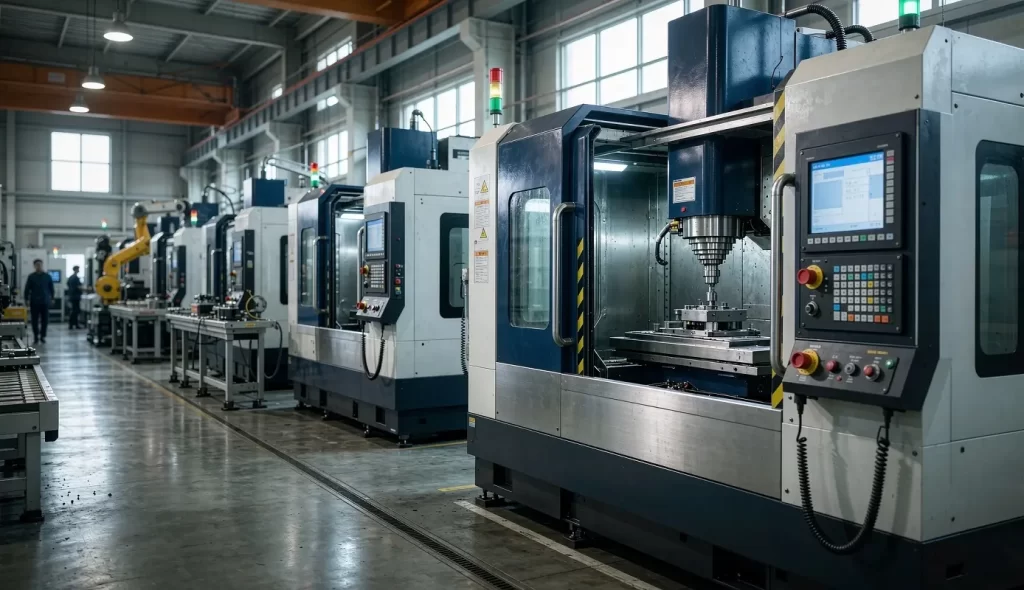
CNC machining centers are utilized in a variety of fields, including the aerospace, automotive, medical equipment, electronics, energy and industrial manufacturing sectors. These machines are essential for businesses to create parts that meet very tight tolerances, have a high-quality surface finish, and are consistent in quality.
Precision manufacturers have adopted the CNC machining centers and combined with other CNC processing technologies such as CNC milling, CNC turning, and Swiss-type machining to offer end-to-end production solutions to prototype and high-volume manufacturing.
How Does a CNC Machining Center Work?
The process of CNC machining center operation relies on computer programming, automatic tooling system and accurate mechanical movement.
Typically, the manufacturing process comprises of a number of important stages:
1. CAD Design and CNC Programming
It begins with a 3D CAD model, designed by engineers. After making the design, it is sent to a CAM software to be converted to CNC instructions or G-code.
The CNC controller then takes these instructions and operates:
- Cutting tool movement
- Spindle speed
- Feed rate
- Tool changes
- Coolant systems
- Machining sequences
This automated process reduces human errors and ensures consistent production quality.
2. Automatic Tool Changing
One of the biggest advantages of CNC machining centers is the automatic tool changer (ATC).
A single machine can automatically change different cutting tools such as:
- End mills
- Drills
- Reamers
- Tapping tools
- Boring tools
This enables a number of machining operations to be performed without removing the work piece.
3. Multi-Axis Machining
CNC machining centers are available in different configurations:
3-Axis CNC Machining Center
A 3-axis machine moves along:
- X-axis
- Y-axis
- Z-axis
It is suitable for many standard components such as plates, brackets, housings, and mechanical parts.
4-Axis CNC Machining Center
A rotary axis is added, allowing machining around the workpiece without multiple setups.
5-Axis CNC Machining Center
A 5-axis machining center provides advanced flexibility by allowing simultaneous movement across five axes. It is ideal for:
- Aerospace components
- Complex medical parts
- Mold manufacturing
- High-precision industrial components
CNC Machining Center vs CNC Milling Machine: What Is the Difference?
Many people confuse CNC machining centers with CNC milling machines because both use rotating cutting tools.
The main difference is automation capability.
A CNC milling machine typically performs milling operations, while a CNC machining center includes additional features such as:
- Automatic tool changers
- Multiple machining functions
- Higher automation levels
- Integrated production systems
Because of these advantages, CNC machining centers are better suited for complex parts and continuous production environments.
For example, precision manufacturers use vertical CNC machining centers for flat and rectangular components such as fixtures, molds, and precision plates.
Key Benefits of Using CNC Machining Centers
1. High Precision and Repeatability
Precision is one of the biggest advantages of CNC machining centers.
Computer-controlled movement allows manufacturers to achieve extremely accurate dimensions and consistent results across thousands of parts.
This makes CNC machining ideal for industries where quality requirements are strict, including:
- Aerospace
- Medical devices
- Automotive systems
- Electronics manufacturing
2. Increased Production Efficiency
Traditional machining often requires multiple machines and manual adjustments.
A CNC machining center can complete multiple operations in one setup, reducing:
- Production time
- Labor requirements
- Setup errors
- Manufacturing costs
Manufacturers can produce more parts in less time while maintaining stable quality.
3. Complex Part Manufacturing
Modern products often require complicated geometries that cannot be produced efficiently using conventional equipment.
CNC machining centers can manufacture:
- Curved surfaces
- Internal cavities
- Precision holes
- Complex mechanical structures
Advanced multi-axis machining technology provides manufacturers with greater design freedom.
4. Reduced Labor Costs
Since CNC machining centers rely heavily on automation, operators can manage multiple machines simultaneously.
This improves productivity while reducing dependence on manual machining skills.
Many advanced machine shops also use automated production systems and lights-out manufacturing methods to increase efficiency.
Common Applications of CNC Machining Centers
CNC machining centers are used across many industries.
Aerospace Industry
Aerospace manufacturers require lightweight but extremely strong components.
CNC machining centers produce:
- Aircraft brackets
- Engine components
- Structural parts
- Precision assemblies
Medical Industry
Medical equipment requires strict accuracy and reliability.
CNC machining is commonly used for:
- Surgical instruments
- Medical device components
- Implant-related parts
- Laboratory equipment
Automotive Manufacturing
Automotive companies use CNC machining centers for:
- Engine components
- Transmission parts
- Custom prototypes
- Production tooling
Electronics Industry
The electronics sector benefits from CNC machining for producing:
- Aluminum housings
- Heat sinks
- Precision connectors
- Equipment frames
Materials Used in CNC Machining Centers
A major advantage of CNC machining is material flexibility.
Common materials include:
Metals
- Aluminum
- Stainless steel
- Carbon steel
- Brass
- Copper
- Titanium
Plastics
- ABS
- Nylon
- PEEK
- Delrin
Choosing the correct material depends on:
- Strength requirements
- Weight limitations
- Temperature resistance
- Chemical exposure
- Cost considerations
How to Choose a CNC Machining Center Supplier?
Selecting the right CNC machining partner is critical for product quality and manufacturing success.
Companies should consider the following factors:
1. Manufacturing Capability
A reliable supplier should have:
- Modern CNC equipment
- Multi-axis machining capability
- Quality inspection systems
- Prototype and production experience
2. Industry Experience
Choose a manufacturer familiar with your industry requirements.
For example, aerospace and medical applications require different quality standards compared with general industrial components.
3. Quality Control
A professional CNC machining supplier should provide:
- Dimensional inspection
- Material verification
- Process control
- Quality documentation
4. Production Flexibility
The best machining partners can support:
- Low-volume prototypes
- Small batch production
- Large-scale manufacturing
- Just-in-time delivery
A precision machining company that is experienced will offer prototype development solutions as well as high volume production solutions.
Why CNC Machining Centers Are Essential for Modern Manufacturing
CNC machining centers are still an important part of the manufacturing industry at present since industries are looking for faster production, tighter tolerances, and complex designs.
Advanced automation, multi axis motion, high repeatability makes CNC machining centers enable manufacturers to gain the following benefits:
- Better product quality
- Faster production cycles
- Lower manufacturing costs
- Greater design flexibility
CNC machining centers are essential tools for achieving precision and efficiency in today's competitive manufacturing landscape, whether used to create a single prototype or mass-produce precision components.
Conclusion
The CNC machining center is not just a cutting machine, it's a complete precision manufacturing solution. CNC machining centers are a combination of computer control, automation, and advanced machining technology that enables companies to create high-quality, tough components for all over the world.
To maximize performance, reduce lead times and production costs, CNC manufacturing solutions need to be advanced and experienced at the hands of a manufacturer that boasts modern machinery and engineering skills.
Talk to the Manufacturer, Not a Middleman
Resources & Insights
-
 Hide blog post
CNC Machining Robotic Parts: How GD&T Controls Robot Assembly Accuracy
2026-09-24By KT Engineering -
 Hide blog post
Hardware Stamping Springback Control for High-Strength Steel Parts
2026-09-24By KT Engineering -
 Hide blog post
Spring Stamping Fatigue Life: How Geometry, Material and Edge Quality Affect Cycle Life
2026-09-24By KT Engineering -
 Hide blog post
Mechanical Automation Parts for Robot End Effectors and Positioning Accuracy
2026-09-23By KT Engineering