Contact Us
 Home /
CNC Parts Manufacturing with 5-Axis: One-Setup Cost and Accuracy Guide


Table of Contents
- Multiple Setups Create an Accuracy Chain
- Why One Primary Setup Changes the Error Path
- 3-Axis, 3+2, or Simultaneous 5-Axis?
- Tool Reach Can Be as Important as Setup Count
- Compare Total Cost per Good Part, Not Hourly Rate
- Which Parts Are Strong Candidates?
- Batch Size Changes the Economics
- Workholding Still Determines Process Stability
- Precision Must Be Proven on the Finished Part
- When Is One-Setup 5-Axis CNC Parts Manufacturing Worth It?

In CNC Parts Manufacturing, choosing 5-axis machining should not begin with the number of axes. It should begin with the drawing.
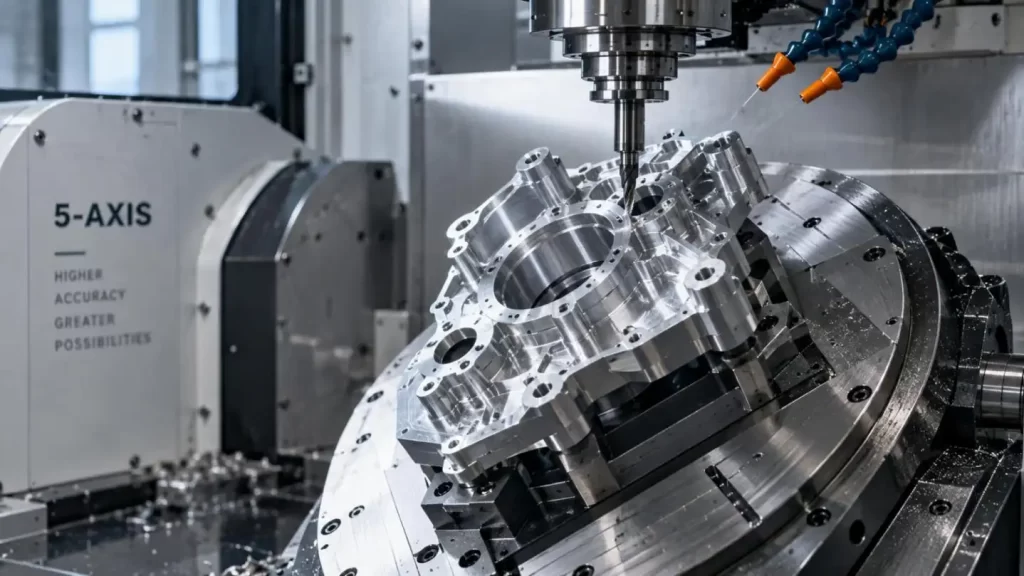
If a component has multiple machined faces, compound-angle holes, deep cavities, freeform surfaces, or tight positional relationships between features on different sides, conventional 3-axis machining may require several setups. Each re-clamping operation adds time, another locating cycle, and another opportunity for datum-transfer error.
For complex parts, the real question is therefore:
Does the higher cost of 5-axis machining eliminate enough setup, fixture, inspection, and quality risk to reduce the total cost per acceptable part?
Multiple Setups Create an Accuracy Chain
Suppose a housing requires a bearing bore on one side, mounting holes on another, and a sealing face perpendicular to both. With conventional CNC Parts Manufacturing, the process may require three or four separate orientations.
Every new setup can introduce:
• Fixture locating variation
• Datum-transfer error
• Clamping deformation
• Probe or edge-finding variation
• Additional inspection requirements
• Feature-to-feature tolerance accumulation
This becomes important when the drawing controls position, perpendicularity, profile, runout, or other cross-face GD&T requirements.
A dimension may be easy to hold independently, yet the relationship between two features machined in different setups may be much harder to control.
Why One Primary Setup Changes the Error Path
In multi-setup machining, critical features may follow a chain such as:
Primary Datum → Secondary Setup → Transferred Datum → Final Feature
5-axis CNC Parts Manufacturing can keep more critical surfaces within one machine coordinate system. The rotary axes reposition the workpiece instead of requiring the operator to repeatedly remove and relocate it.
This does not eliminate error. Accuracy still depends on:
• Rotary-axis calibration
• Machine thermal stability
• Tool length and wear
• Fixture rigidity
• Probe accuracy
• Material stability
• CAM strategy
The benefit is that unnecessary re-fixturing variables can be removed from the process.
3-Axis, 3+2, or Simultaneous 5-Axis?
More complex does not automatically mean simultaneous 5-axis. A reliable CNC Parts Manufacturing process uses the simplest method that reliably satisfies the drawing.
| Machining Strategy | Best Application | Main Trade-Off |
| 3-Axis Multi-Setup | Simple blocks, plates, accessible features | More setups for multi-face parts |
| 3+2 Indexed Machining | Angled holes, pockets, multiple planar faces | Tool angle remains fixed during each cut |
| Simultaneous 5-Axis | Freeform surfaces, impellers, complex contours | Higher CAM and machine requirements |
For example, a part with holes on five different faces may need only 3+2 machining. The machine indexes the workpiece to the required orientation and then cuts with conventional three-axis motion.
Simultaneous 5-axis is more appropriate when tool orientation must continuously change during cutting.
KT's 5-axis capability includes simultaneous 5-axis machining rather than only 3+2 positioning. Equipment listed by KT includes the Mazak VARIAXIS i-500 with a 500 mm table and 18,000 RPM spindle, as well as DMG MORI 5-axis equipment.
Tool Reach Can Be as Important as Setup Count
Deep cavities are another reason to evaluate 5-axis CNC Parts Manufacturing.
A 3-axis process may require a long-reach cutter because the spindle must approach vertically. Increasing tool overhang reduces system stiffness.
The typical relationship is:
Longer Overhang → More Tool Deflection → Greater Chatter Risk → Poorer Dimensional and Surface Control
By tilting the workpiece, a 5-axis machine may allow a shorter cutter to approach the same feature.
This can improve:
• Cutting rigidity
• Surface finish consistency
• Tool life
• Wall accuracy
• Deep-pocket accessibility
This is especially relevant for mold inserts, robotic components, aerospace structures, and complex automation housings.
https://youtube.com/shorts/wcNubkaIvj8?feature=share
Compare Total Cost per Good Part, Not Hourly Rate
One of the most common sourcing mistakes is comparing only machine-hour prices.
For CNC Parts Manufacturing, the real cost equation includes:
CAM Programming + Fixtures + Setup Labor + Cutting Time + Inspection + Rework + Scrap
Consider the manufacturing routes below:
| Cost Factor | 3-Axis Multi-Setup | 5-Axis One Primary Setup |
| Machine hourly cost | Lower | Higher |
| CAM complexity | Lower | Higher |
| Number of setups | Higher | Lower |
| Custom fixture demand | Often higher | Often lower |
| Datum-transfer risk | Higher | Lower |
| Intermediate inspection | Often higher | Lower potential |
| Rework risk | Geometry-dependent | Reduced for suitable parts |
5-axis machining becomes easier to justify when several cost drivers occur together—not simply because the component "looks complex."
Which Parts Are Strong Candidates?
From a CNC Parts Manufacturing perspective, one-primary-setup machining deserves serious evaluation when the part has:
• Four or more otherwise necessary setups
• Critical features on several faces
• Compound-angle holes or pockets
• Tight cross-face positional tolerances
• Deep cavities requiring excessive tool reach
• Undercuts or difficult tool access
• Continuous freeform surfaces
• Expensive material where scrap carries high cost
By contrast, a simple plate or prismatic block with loose tolerances may be produced more economically on a 3-axis machine.
Batch Size Changes the Economics
For prototypes and low-volume CNC Parts Manufacturing, 5-axis machining can reduce the need to design and manufacture several dedicated fixtures.
For repeat production, other factors become more important:
• Fixture repeatability
• Cycle time
• Tool wear compensation
• In-process probing
• Inspection frequency
• Process capability
A first article that meets tolerance does not prove that the same process will remain stable over 100 or 500 parts. Production planning must control variation, not merely produce one accurate component.
Workholding Still Determines Process Stability
"One setup" does not mean "no fixture."
A 5-axis fixture must expose the required surfaces without sacrificing stiffness. Depending on the part, this may involve:
• Soft jaws
• Dovetail workholding
• Zero-point systems
• Custom fixtures
• Controlled clamping for thin-wall parts
Excessive clamping force can distort thin sections during machining. Once unclamped, the part may spring back and move outside tolerance.
For this reason, workholding, machining sequence, material stress, probing, and inspection should be planned as one system.
Precision Must Be Proven on the Finished Part
Machine positioning accuracy should never be treated as finished-part tolerance.
KT offers typical CNC Parts Manufacturing tolerance at approximately ±0.05 mm, with high-precision capability reaching ±0.005 mm under suitable material, geometry, machine, and process conditions. Its tolerance information also lists complex 5-axis components with tighter capability for appropriate applications.
The important point is that tight tolerance should be applied feature by feature, according to function.
At KT, dimensional control can combine machining process control with CMM inspection and multi-stage quality verification. A demanding bearing seat, datum hole, or sealing interface should therefore be evaluated differently from a non-critical external surface.
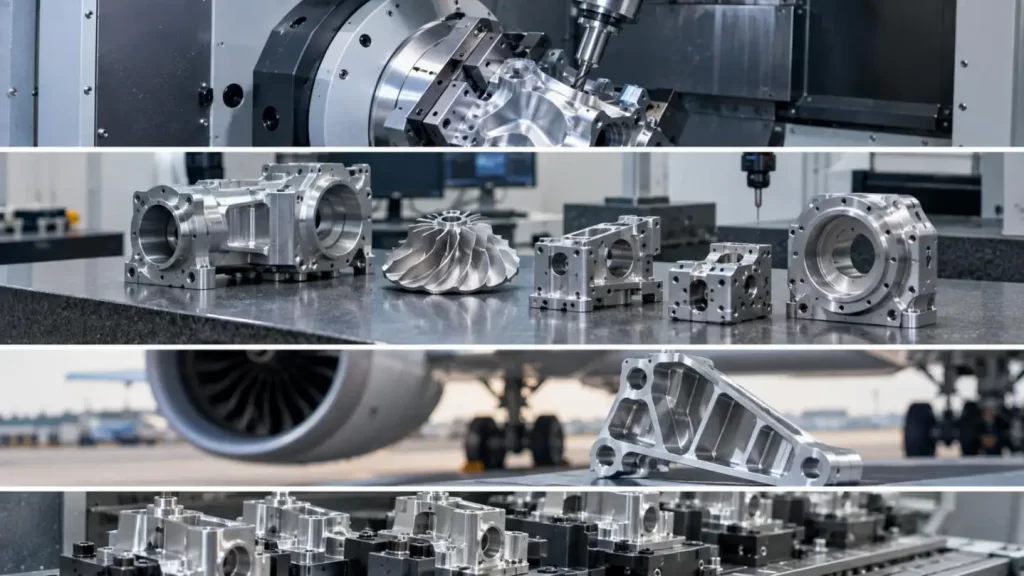
When Is One-Setup 5-Axis CNC Parts Manufacturing Worth It?
5-axis machining is worth considering when its additional programming and machine cost is lower than the combined cost of:
Extra Setups + Fixtures + Datum-Transfer Risk + Inspection + Rework + Rejected Parts.
Before approving a CNC Parts Manufacturing quotation, buyers should ask:
• How many physical setups are required?
• Is the proposed process 3+2 or simultaneous 5-axis?
• Which critical features remain in one datum system?
• What workholding strategy will be used?
• How will critical GD&T characteristics be inspected?
• Is the process optimized for prototype quantities or repeat production?
KT supports 3-axis through simultaneous 5-axis CNC Parts Manufacturing, with DFM review, precision inspection, and prototype-to-production capability. For complex multi-face parts, submitting the 2D drawing and 3D model allows the engineering team to evaluate whether 5-axis one-setup machining actually improves manufacturability and total production cost—not simply whether the part can be machined on a 5-axis machine.
FAQs
Q1. Does KT provide 5-axis CNC Parts Manufacturing?
Yes. KT supports 3-axis, 4-axis and simultaneous 5-axis CNC machining for parts ranging from relatively simple components to complex multi-face geometries.
Q2. What tolerance can KT achieve in CNC Parts Manufacturing?
KT offers typical CNC machining tolerances around ±0.05 mm, with high-precision capability down to approximately ±0.005 mm for suitable features, materials and process conditions.
Q3. Does KT offer simultaneous 5-axis machining or only 3+2 machining?
KT has simultaneous 5-axis CNC machining capability. However, its engineers can also select 3+2 machining when continuous five-axis interpolation is unnecessary.
Q4. How does KT decide whether a part requires 5-axis machining?
The decision can consider machined face count, compound angles, tool accessibility, deep cavities, GD&T requirements, setup count, batch size and total manufacturing cost.
Q5. Can KT manufacture complex parts in one setup?
Many critical features can be machined in one primary setup when geometry and workholding allow. Some parts may still require secondary operations for clamping surfaces, bottom faces or finishing.
Talk to the Manufacturer, Not a Middleman
Resources & Insights
-
 Industry Insights
CNC Machining Robotic Parts: How GD&T Controls Robot Assembly Accuracy
2026-09-24By KT Engineering -
 Industry Insights
Hardware Stamping Springback Control for High-Strength Steel Parts
2026-09-24By KT Engineering -
 Industry Insights
Spring Stamping Fatigue Life: How Geometry, Material and Edge Quality Affect Cycle Life
2026-09-24By KT Engineering -
 Industry Insights
Mechanical Automation Parts for Robot End Effectors and Positioning Accuracy
2026-09-23By KT Engineering