Contact Us
  Home /
 Custom Boat Components for Saltwater Use: Materials, Corrosion and Tolerance


Table of Contents
- Importance of Selecting the Right Material for Custom Boat Components
- Marine-Grade Materials for Custom Boat Components
- Galvanic Corrosion: A Critical Design Risk
- Surface Treatments for Custom Boat Components
- Why CNC Tolerance Matters for Custom Boat Components
- What Influences the Precision of CNC Machining?
- KT TOOL Manufacturing Capability

The decision-making process of custom boat component fabrication does not stop at comparing tensile strength, weight, and price of raw materials. Components will be subjected to chloride attack by salt water; corrosion will be accelerated by galvanic action; constant moisture and vibration will be present; UV exposure and cyclic loading will be experienced. 316/316L stainless steels, marine-grade aluminum, bronze, and some engineering plastics are often used. However, the right material will depend on exposure, the path of loading, the metal(s) to which the material will be joined, surface treatments, the degree of sealing and the closeness of fit during machining.
Importance of Selecting the Right Material for Custom Boat Components
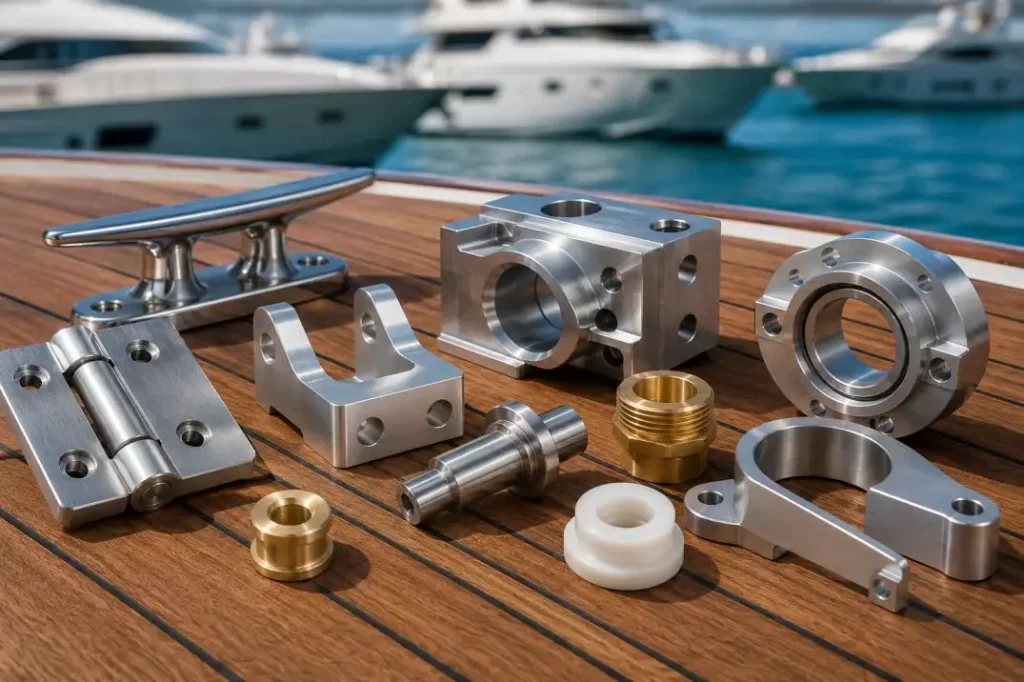
Marine fittings are subjected to conditions that will rapidly corrode fittings and lead to mechanical failures of the fittings. The material selected for an internal machine may be very different from the material selected for a deck fitting, a fitting near an engine compartment, or fittings below the waterline.
There are four major corrosion and failure conditions that must be dealt with when selecting materials for custom boat components:
•Exposure to salts and chloride: Salt water will lead to pitting and crevice corrosion, especially around bolt fasteners and joints as well as areas with stagnant water.
•Galvanic action: In the presence of salt water, dissimilar metals become an electrochemical cell.
•Moisture trapping: Salt water will become trapped in fasteners with blind holes and in joints with poor drainage.
•Cyclic loading: The action of waves will cause loading; the constant vibration from the engine will cause a fatigue and fretting.
For Custom Boat Components, the best alloy is not the most corrosion resistant. The best alloy is the balance between most corrosion resistant, the best mechanical performance, the best protection and the most cost effective.
Marine-Grade Materials for Custom Boat Components
| Material | Marine Performance | Machining | Typical Custom Boat Components | Engineering Consideration |
| 316/316L Stainless Steel | High chloride resistance | Good | Cleats, hinges, shafts, brackets, fasteners | Strong but relatively heavy |
| 5083 Aluminum | Very good marine corrosion resistance | Good | Structural parts, panels, housings | Well suited to welded marine structures |
| 6061 Aluminum | Good with suitable protection | Excellent | CNC brackets, mounts, frames | Easy to machine; finishing often recommended |
| Marine Bronze/Brass | Good in selected marine conditions | Good | Bushings, fittings, valves | Alloy selection must match the application |
| Engineering Plastics | No electrochemical rust | Excellent | Bushings, guides, spacers, insulators | Check load, creep, UV, and temperature limits |
When 316/316L Stainless Steel Is Preferred
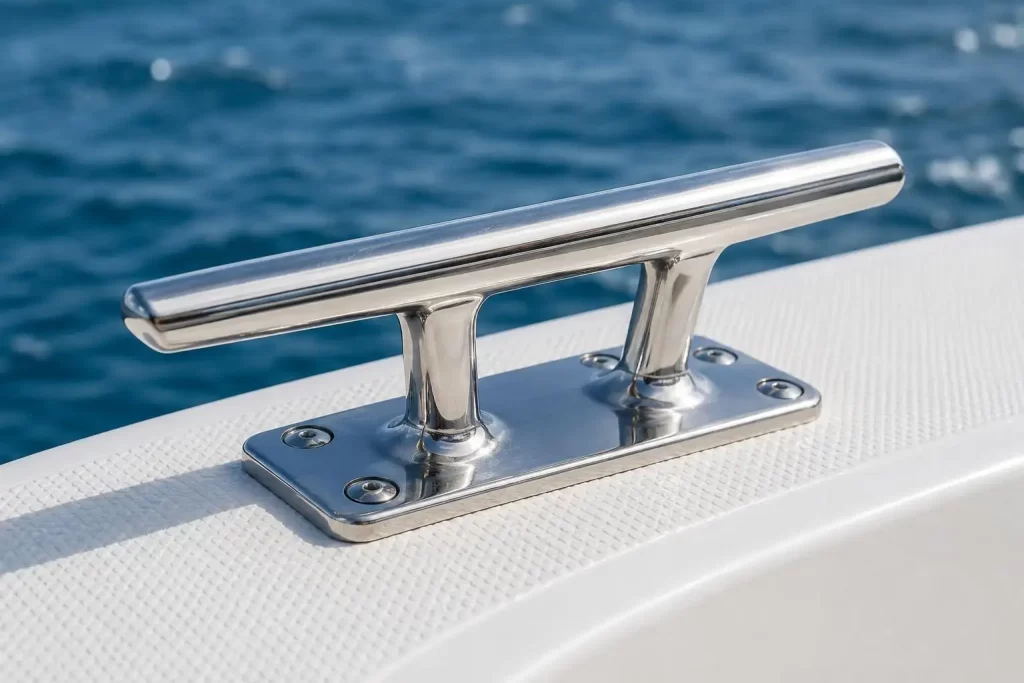
316-series stainless steel is commonly considered for Custom Boat Components that require high strength and strong resistance to chloride-containing environments, such as:
•Deck hardware
•Hinges and cleats
•Shafts
•Precision fasteners
•Load-bearing brackets
•Marine fittings
Its disadvantages are higher density and generally greater machining effort than aluminum.
When Aluminum Makes More Sense
Aluminum is attractive when component mass matters. Typical aluminum Custom Boat Components include:
•Equipment housings
•Mounting plates
•Structural brackets
•Frames and covers
•Electronic enclosures
5083 is widely associated with marine structures, while 6061 offers favorable CNC machinability. However, alloy choice, anodizing, coating, and contact with other metals must be considered together.
Galvanic Corrosion: A Critical Design Risk
A common design condition is:
Aluminum part + stainless steel fastener + seawater
While each material may have the capacity to resist corrosion, the combination of the materials may galvanically corrode if all the criteria necessary for galvanic corrosion to occur are satisfied; these are contact between the materials, an electrolyte and an electrical circuit.
The Custom Boat Components engineers can minimize galvanic corrosion risk by:
•Choosing compatible materials
•Isolating the metals by inserting a polymer washer or bushing
•Using non-conductive gaskets if possible
•Preventing contact between the metals and allowing the entry of an electrolyte
•Designing to avoid trapping recesses for seawater
•Including drainage
•Using the proper coating or anodizing
•Considering the use of sacrifical protection if required
Galvanic compatibility is a design issue; it should not be corroded compatible materials discovered post service.
Surface Treatments for Custom Boat Components
Surface finishing can improve corrosion or wear performance, but it cannot correct an unsuitable base material or poor joint design.
| Treatment | Material | Main Purpose | Typical Use |
| Passivation | Stainless steel | Improve passive surface condition | Fasteners, brackets, fittings |
| Anodizing | Aluminum | Increase surface protection | Housings, mounts, frames |
| Hard Anodizing | Aluminum | Improve wear and surface hardness | Sliding or high-wear parts |
| Powder Coating | Aluminum/steel | Barrier protection | Covers, structural parts |
| Electropolishing | Stainless steel | Improve surface condition | Exposed precision hardware |
An important machining detail is that coatings and anodized layers can influence final dimensions. Fits, threads, seal grooves, and bearing seats should therefore be designed with the finishing process in mind.
Why CNC Tolerance Matters for Custom Boat Components
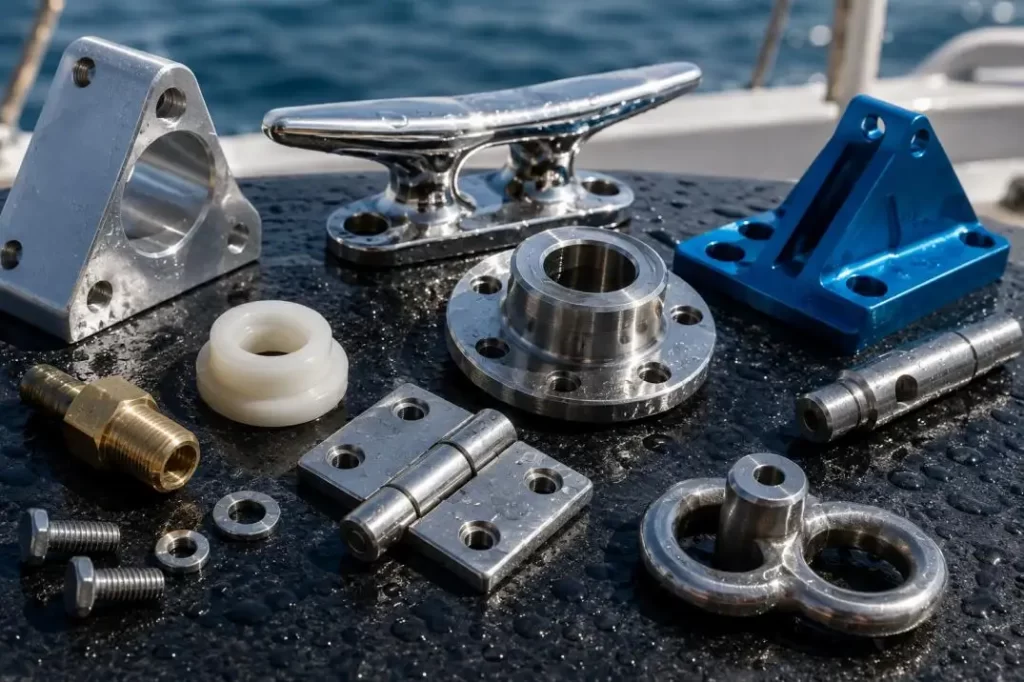
In addition to dimensional inspection, Custom Boat Components' tolerancing impacts the functionality of products due to the effects on component fit, the integrity of sealing, alignment, and the ability of the component to withstand repeated loads in a marine environment.
Fit and Alignment
Some Examples of critical features are
•Shaft-to-bushing interface
•Bearing bores
•Hinge axes
•Fastener patterns
•Locating holes
•Mating faces
These can cause interference, misalignment, uneven loads and may result in clearance and even premature failure of a component.
Sealing Performance
These interfaces are the machined housings and may include O-ring grooves, gasket seats, and bolted flanged covers.
Inadequate control of sealing surfaces and interfaces can cause:
•Insufficient compression of the gasket
•Excessive O-ring squeeze
•Asymmetric sealing surfaces
•Localized gaps
•Increased risk of water ingress
Vibration and Wear
Seafaring components and equipment are subjected to the harshest of conditions. Loading is further compounded by impact. If fit is insufficient, it can cause vibration, noise, excessive clearance, and even bearing wear along with loosening fasteners.
Precision Should Be Functional
Custom Boat Components does not need every dimension to be within ±0.005 mm (mechanically perfect) for every component.
More stringent tolerances should be applied to:
•Bearing and Shaft fits
•Seal grooves
•Alignment features
•Precision bores
•Functional interfaces
While the following can have standard tolerances in:
•Clearance profiles
•Decorative surfaces
•Non-functional dimensions
•General external geometry
This method drastically limits the cost of inspection and the cost to perform the machining.
What Influences the Precision of CNC Machining?
Factor Influence on Manufacturing
| Material stability | Movement (dimensions) caused by residual stress and thermal expansion |
| Part geometry | Deformation of the part caused by geometry (e.g. thin walls, deep pockets) |
| Fixturing | Part distortion caused by excessive clamping on lightweight parts |
| Tool condition | Wear (tool) affects dimensions and surface finish |
| Machine capability | Repeatability (tool) affects process consistency |
| Temperature | Effects of thermal variations on both machining and inspection |
| Finishing | Anodized/ coated surfaces may have variations of critical dimensions |
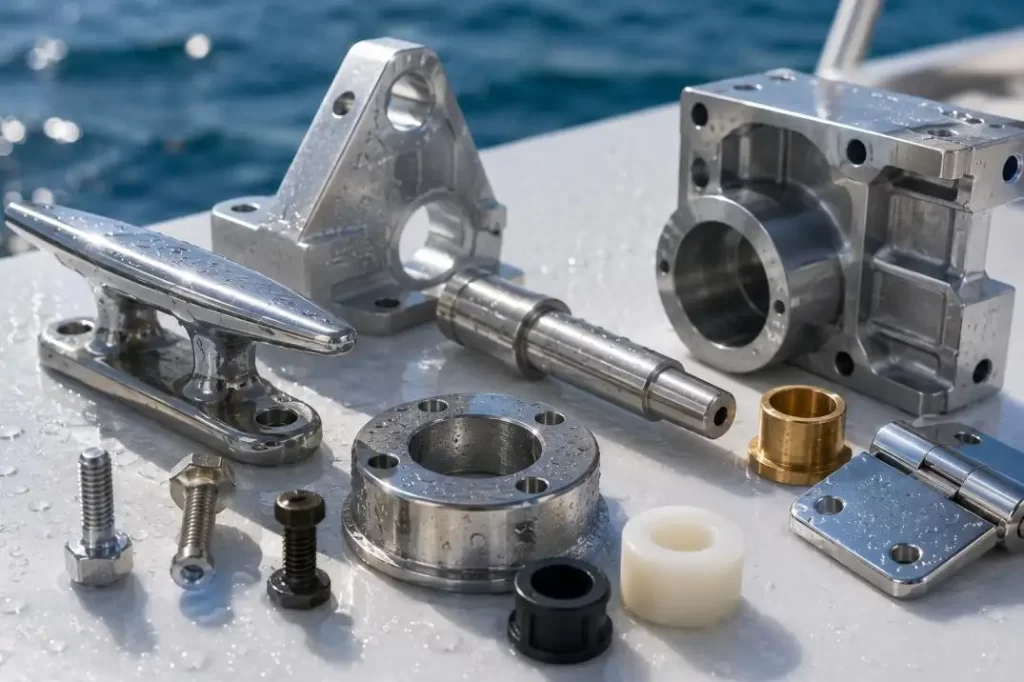
When considering Precision Custom Boat Components, planning tolerances will have to consider the entire process from raw material to machining, finishing, and inspection.
KT TOOL Manufacturing Capability
| Process | Typical Tolerance | High-Precision Capability* |
| CNC Machining | ±0.05 mm | ±0.005 mm |
| Sheet Metal Fabrication | ±0.10 mm | ±0.05 mm |
| Metal Stamping Tooling | ±0.05 mm | ±0.02 mm |
| Die Casting | ±0.10 mm | ±0.05 mm |
| Injection Molding | ±0.10 mm | ±0.02 mm |
| Tool & Die | ±0.02 mm | ±0.005 mm |
| 5-Axis CNC | ±0.03 mm | ±0.002 mm |
Actual capability depends on material, geometry, part size, feature accessibility, machining strategy, and inspection requirements.
Engineering Custom Boat Components at KT TOOL
KT TOOL approaches Custom Boat Components through a manufacturing workflow rather than applying the same tolerance or process to every feature.
Key steps include:
•Material review: saltwater exposure, load, weight, mating metals, and finish
•DFM analysis: thin walls, deep cavities, tool access, datum structure, and tolerance stack-up
•Tolerance classification: functional, mating, sealing, and non-critical dimensions
•Process selection: CNC machining, 5-axis machining, sheet metal, tooling, die casting, or injection molding
•Inspection: CMM measurement, critical-feature verification, process monitoring, and final dimensional checks
Final Words
For Custom Boat Components to be made successfully, all parts of the engineering system must be considered: selection of marine-grade materials, galvanic compatibility, geometry that considers drainage, appropriate surface finish, tolerances, and manufacturing control.
With the capability of providing DFM, precision CNC machining, multi-process manufacturing and dimensional inspection, KT TOOL is able to assist in the development of new Custom Boat Components, or the redesign of existing Custom Boat Components. To provide the best possible manufacturing solution for your marine components, please provide your drawings and additional information on your target material, quantity, tolerances, and the intended operational environment of the components.
FAQs
Q1. What materials does KT TOOL use for Custom Boat Components?
We can make Custom Boat Components from 316/316L stainless steel, aluminum alloys, copper alloys, engineering plastics and more. The final choice of materials should take into account exposure to saltwater, type and magnitude of the mechanical load, weight, how it interacts with other materials, corrosion considerations, and any required finishing.
Q2. Can KT TOOL machine 316 stainless steel Custom Boat Components?
Yes. KT TOOL is capable of CNC machining stainless steel, including 316 and 316L, Custom Boat Components. 316 stainless steel and 316L are popular choices for marine brackets, hinges, fasteners, shafts, fittings, and other components that are exposed to chloride containing environments.
Q3. Which aluminum alloys are suitable for Custom Boat Components?
5083 aluminum has great corrosion resistance and is a popular choice for marine structures. 6061 aluminum is popular for Use in CNC machined brackets, mounts, housings, and frames due to its ease of machining. KT TOOL is able to assess the use of these alloys based on the application and manufacturing needs.
Q4. How does KT TOOL control tolerances for CNC machined boat components?
During DFM and machining planning, KT TOOL focuses on the key attributes such as bearing bores, shaft interfaces, seal grooves, and important surfaces and holes. The typical tolerance for CNC machining is around ±0.05 mm.
Q5. Can KT TOOL manufacture high-precision Custom Boat Components?
Yes. Depending on the complexity of the project, KT TOOL is able to use precision CNC and 5-axis machining for Custom Boat Components. The high level of precision for this type of project is dependent on the stability of the material, the geometry of the component, accessibility of the features, how the component is held, the machining strategy, and the type of inspections that are performed.
Talk to the Manufacturer, Not a Middleman
Resources & Insights
-
 Industry Insights
CNC Machining Robotic Parts: How GD&T Controls Robot Assembly Accuracy
2026-09-24By KT Engineering -
 Industry Insights
Hardware Stamping Springback Control for High-Strength Steel Parts
2026-09-24By KT Engineering -
 Industry Insights
Spring Stamping Fatigue Life: How Geometry, Material and Edge Quality Affect Cycle Life
2026-09-24By KT Engineering -
 Industry Insights
Mechanical Automation Parts for Robot End Effectors and Positioning Accuracy
2026-09-23By KT Engineering