Contact Us
  Home /
 how does a 3d printer work


Table of Contents

3D Printing has revolutionized the design, prototyping and manufacturing of products. From hobbyists creating custom figurines to engineers producing functional prototypes and medical professionals printing personalized implants, this revolutionary technology is changing industries worldwide.
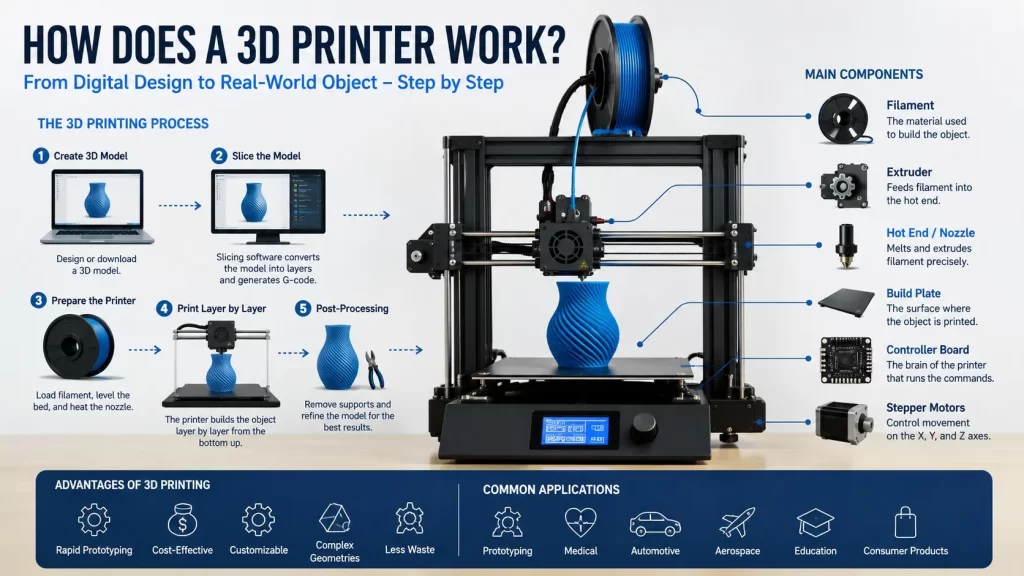
But how does a 3D printer work?
This guide will teach you how 3D printers create physical objects from digital designs, explain the various methods of 3D printing, and give you an overview of the entire printing process.
What Is a 3D Printer?
A 3D printer is a machine that builds up objects from layers of material in a three-dimensional form according to a digital design. Additive manufacturing is a method of 3D printing, compared to traditional manufacturing methods where material is cut or milled.
It starts with a computer drawn 3D model, or a model downloaded from the internet library of 3D models. This model is then sliced into thousands or hundreds of thin layers using specialized software which the printer follows precisely.
Since the 3D printer only deposits the material where it is required, the production process reduces waste, and can create highly complex geometries that would otherwise be difficult or impossible to manufacture.
How Does a 3D Printer Work?
There are various 3D printing technologies, but they all share similar workflows, albeit employing different material and technique.
Step 1: Create or Download a 3D Model
Every print starts with a digital design.
Users can:
- Design models using CAD software
- Scan existing objects with a 3D scanner
- Download ready-made STL or OBJ files from online repositories
The quality of the digital model directly affects the final printed object.
Step 2: Slice the Model
The 3D model is not suitable to be printed directly.
Instead, slicing software like Cura or PrusaSlicer or OrcaSlicer divides up the model into hundreds of thin horizontal slices and translates them into instructions for the machine (G-code).
The slicer also sets important print settings such as:
- Layer height
- Print speed
- Infill density
- Support structures
- Printing temperature
- Cooling settings
These parameters significantly influence print quality, strength, and printing time.
Step 3: Prepare the Printer
Before printing begins, the machine must be prepared.
Depending on the printer type, preparation may include:
- Loading filament or resin
- Heating the nozzle
- Heating the build plate
- Leveling the print bed
- Calibrating the print head
- Checking material flow
Proper calibration ensures excellent first-layer adhesion, which is essential for successful printing.
Step 4: Print Layer by Layer
With the preparation complete, the printer begins to print the object.
It builds up the object, layer by layer rather than making it all at once.
The layers are each only about a fraction of a millimetre thick and sometimes as thin as 0.1 mm to 0.3 mm.
The printer, with a high level of precision, deposits or solidifies the material layer by layer, based on the sliced design, until the whole object is completed.
This is a method of add-on manufacturing that provides intricate internal structures, lightweight designs and highly customized parts that traditional manufacturing methods cannot easily produce.
Step 5: Cooling and Post-Processing
After printing finishes, additional work may be required.
Common post-processing steps include:
- Removing support structures
- Washing resin prints
- UV curing
- Sanding surfaces
- Painting
- Polishing
- Heat treatment (for metal parts)
The amount of finishing depends on the printing technology and desired surface quality.
How FDM 3D Printers Work
Consumers and small businesses are most likely to use 3D printing technology, and that is fused deposition modeling or FDM.
It does this by liquefying plastic filament and extruding it through a hot nozzle.
The process includes:
- Feeding filament into the extruder
- Heating the filament until it melts
- Extruding molten plastic onto the build plate
- Following precise X and Y movements
- Raising or lowering the Z-axis after each completed layer
- Repeating until the object is complete
Popular FDM materials include:
- PLA
- PETG
- ABS
- TPU
- Nylon
- Carbon fiber reinforced composites
FDM printers are widely used for:
- Functional prototypes
- Engineering parts
- Educational projects
- Household tools
- DIY products
Their affordability, ease of use, and broad material compatibility make them ideal for beginners.
How Resin 3D Printers Work
Resin printers operate on the same principle as plastic filament printers, but they use a liquid photopolymer rather than plastic filament.
They don't melt material, but rather cure it with ultraviolet (UV) light in layers of liquid resin.
The process involves:
- Filling the resin vat
- Projecting UV light onto the desired layer
- Hardening only the required areas
- Raising the build platform
- Repeating until completion
After printing, parts must be:
- Washed with isopropyl alcohol (IPA)
- Fully cured under UV light
- Supports removed
Resin printing delivers extremely fine detail and smooth surfaces, making it ideal for:
- Miniatures
- Jewelry
- Dental models
- Medical applications
- High-detail prototypes
How Metal 3D Printers Work
Industrial metal 3D printers operate differently from desktop printers.
Technologies such as:
- Direct Metal Laser Sintering (DMLS)
- Selective Laser Melting (SLM)
use powerful lasers to fuse fine metal powder layer by layer.
The process follows these steps:
- Spread a thin layer of metal powder
- Laser selectively melts the desired areas
- Lower the build platform
- Apply another powder layer
- Repeat until the part is complete
Metal 3D printing is widely used in:
- Aerospace
- Automotive
- Medical implants
- Industrial tooling
- Defense manufacturing
It enables lightweight yet extremely strong components with complex internal geometries.
Main Components of a 3D Printer
Understanding the hardware helps explain how the entire process works.
The major components include:
- Controller Board – Interprets G-code and coordinates all printer movements.
- Extruder – Feeds filament into the hot end.
- Hot End – Melts thermoplastic materials before extrusion.
- Nozzle – Deposits material with high precision.
- Build Plate – The surface where the object is printed.
- Stepper Motors – Control movement along the X, Y, and Z axes.
- Power Supply – Provides electrical power to all components.
- Cooling Fans – Regulate nozzle temperature and improve print quality.
Each part works together to ensure precise layer alignment and consistent print accuracy.
Advantages of 3D Printing
3D printing offers numerous benefits over traditional manufacturing.
Key advantages include:
- Rapid prototyping
- Reduced material waste
- Highly customizable products
- Complex geometries
- Faster product development
- Lower tooling costs
- On-demand manufacturing
- Small-batch production
- Lightweight structural designs
These advantages explain why industries increasingly rely on additive manufacturing for innovation and efficiency.
Common Applications of 3D Printing
Modern 3D printing is used across many sectors, including:
- Product design
- Consumer goods
- Automotive engineering
- Aerospace components
- Medical devices
- Dental aligners
- Architecture models
- Educational projects
- Robotics
- Electronics
- Manufacturing tooling
- Customized replacement parts
New applications are added each year as the type of printing materials evolve.
Final Thoughts
Now that you've read this, you should have a basic understanding of how a 3D printer functions.Now that you're reading this you should have a basic understanding of how a 3D printer works. The idea behind 3D printing is the same, no matter what type of printer you use: create an object by stacking layers of material, whether it's an FDM printer, resin printer, or an industrial metal printer, depending on the project requirement.
The technology of 3D printing has become more commonplace than ever thanks to better hardware, more efficient 3D slicing software and a wide variety of printable materials. It has been used for rapid prototyping through to full-scale manufacturing, and it is continuing to change the way products are designed, produced and customized into the future.
Talk to the Manufacturer, Not a Middleman
Resources & Insights
-
 Hide blog post
CNC Machining Robotic Parts: How GD&T Controls Robot Assembly Accuracy
2026-09-24By KT Engineering -
 Hide blog post
Hardware Stamping Springback Control for High-Strength Steel Parts
2026-09-24By KT Engineering -
 Hide blog post
Spring Stamping Fatigue Life: How Geometry, Material and Edge Quality Affect Cycle Life
2026-09-24By KT Engineering -
 Hide blog post
Mechanical Automation Parts for Robot End Effectors and Positioning Accuracy
2026-09-23By KT Engineering