Contact Us
  Home /
 Metal Housing Parts for Lightweight Designs: Strength, Stiffness and Manufacturing


Table of Contents
- Why Metal Housing Parts Become Unstable After Excessive Weight Reduction
- Strength and Stiffness Are Not the Same
- Wall Thinning, Pocketing or Ribs: Which Strategy Works Better?
- Aluminum, Magnesium or Stainless Steel?
- Match the Lightweight Geometry to the Manufacturing Process
- Do Not Remove Material From Functional Interfaces Blindly
- Design for Assembly and Maintenance
-
Validate Before Production
- Closing Words
-
FAQs
- Q1. Does KT TOOL provide 5-axis machining for complex Metal Housing Parts?
- Q2. Which materials does KT TOOL recommend for lightweight Metal Housing Parts?
- Q3. Can KT TOOL machine thin-wall Metal Housing Parts?
- Q4. How does KT TOOL reduce the weight of Metal Housing Parts?
- Q5. What tolerances can KT TOOL achieve on Metal Housing Parts?

Metal Housing Parts weight reduction cannot simply rely on wall thickness. Housings can also carry circuits, hold alignment for connectors, retain seals, do thermal transfer, provide resistance to vibration, and have threads for mounting.
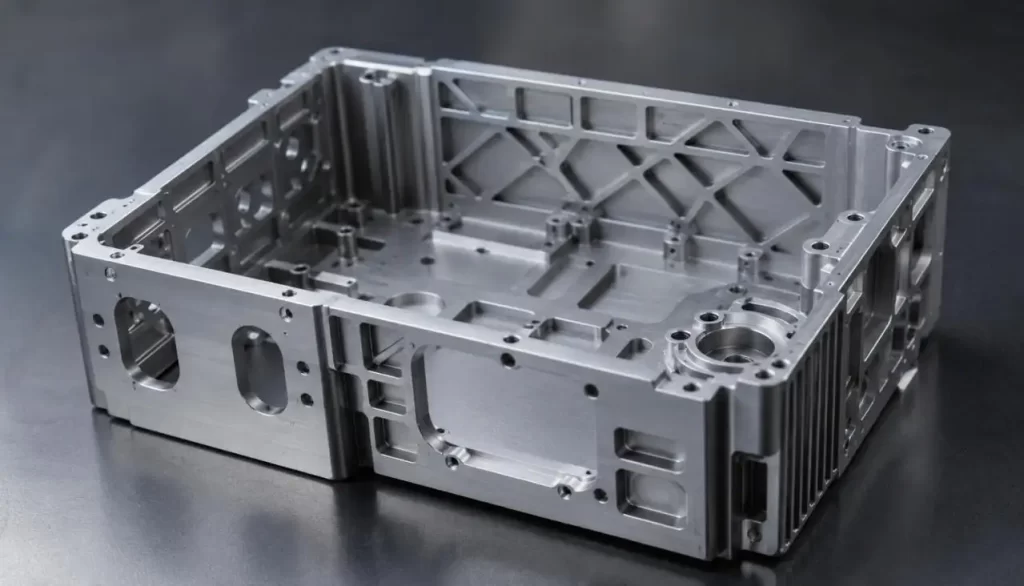
In a lightweight design, material is removed in a way that preserves the important sections for stiffness, load transfer, thermal performance, sealing and tolerance.
For CNC-machined Metal Housing Parts, this balance is especially important because aggressive pocketing and thin walls can also increase machining deformation and production cost.
Why Metal Housing Parts Become Unstable After Excessive Weight Reduction
Large unsupported panels, deep cavities, thin floors, and narrow sidewalls are common deformation risks.
Typical problems include:
•Bowed sidewalls after material removal
•Base-plate warpage
•Loss of sealing-face flatness
•Shifted PCB or connector holes
•Vibration around unsupported panels
•Distortion caused by residual machining stress
For example, KT TOOL's tolerance guidance treats thin walls below approximately 2 mm differently from more rigid structures because flatness becomes increasingly sensitive to material behavior, machining sequence, and clamping.
This is why a target such as "reduce housing weight by 20%" should first identify where material is structurally necessary.
Strength and Stiffness Are Not the Same
One of the most common mistakes in lightweight Metal Housing Parts is selecting a stronger alloy and assuming deformation will automatically decrease.
Two different properties control the problem:
• Yield strength determines when permanent deformation begins.
•Young's modulus controls elastic stiffness under load.
A higher-strength aluminum alloy may resist yielding better, yet its elastic stiffness may remain relatively close to another aluminum alloy.
Wall geometry is often more influential.
For a simplified plate section, bending stiffness is strongly related to the moment of inertia, which increases approximately with the cube of wall thickness. Therefore, reducing a wall from 2.5 mm to 1.5 mm can affect rigidity much more severely than the percentage of material removed suggests.
This is why lightweight housing engineering should evaluate:
•Density
•Young's modulus
•Yield strength
•Unsupported span
•Wall thickness
•Rib geometry
•Load direction
•Safety factor
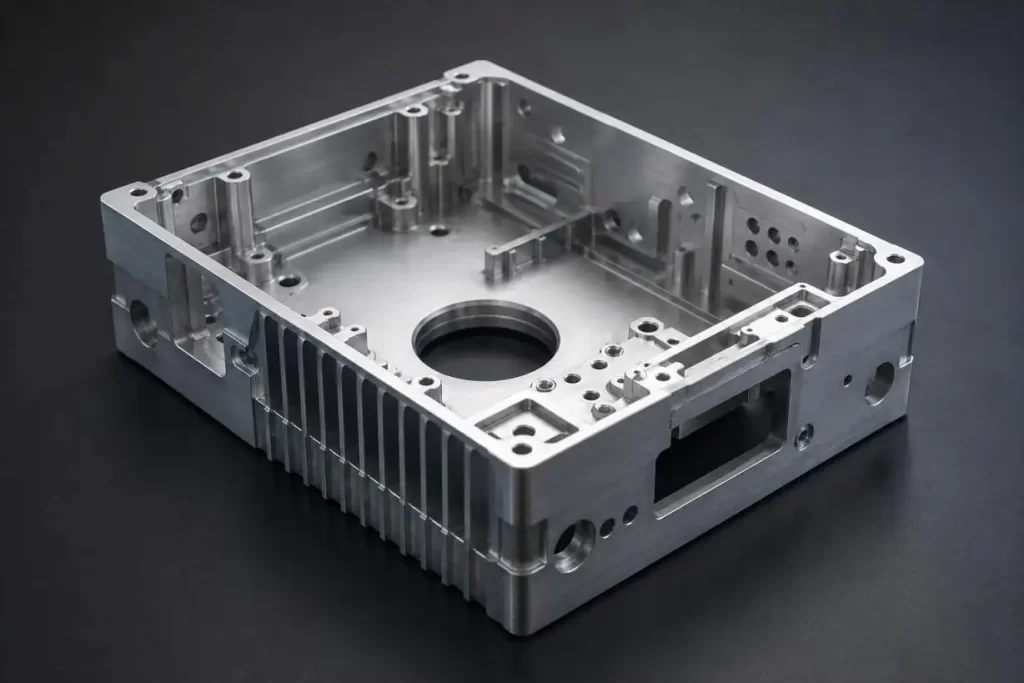
Wall Thinning, Pocketing or Ribs: Which Strategy Works Better?
The approach to lightweighting design varies with different Metal Housing Components.
| Strategy | Lightweighting Impact | Stiffness Risk | Manufacturing Impact |
| Wall thinning uniformly | High | High on large panels | Easy design, but high deformation risk |
| Pocketing uniformly | Medium-High | Localized | Lengthy CNC toolpaths |
| Thin wall + ribs | High | Lower with good design | Complex tool paths |
| Material replacement | Varies | Will need redesign | Impact on cost and finishing |
Wall Thinning Uniformly
Reduction applied uniformly introduces the risk of failure for large, flat, surface components. Uniform wall thinning is best for smaller components and low load applications.
Smart Pocketing
Smart Pocketing involves removing the lower load section of material while retaining surrounding material.
•Mounting bosses
•Screw bosses
•Corners
•Interfaces
•Flanges
Smart pocketing can lead to deep pockets, which will increase the time and cost of machining due to the requirement of long tooling and low feeds.
Rib-Reinforced Walls
A thin wall combined with strategically positioned ribs can provide a better stiffness-to-weight ratio than simply increasing the entire wall thickness.
The ribs should follow actual load paths rather than being added arbitrarily.
Aluminum, Magnesium or Stainless Steel?
Material selection should consider more than density.
| Material | Weight | Strength | Machinability | Thermal Performance | Typical Housing Use |
| 6061 Aluminum | Low | Good | Excellent | High | Electronics, industrial housings |
| 7075 Aluminum | Low | Higher | Good | Good | High-load precision structures |
| Magnesium Alloy | Very low | Moderate-Good | Application-dependent | Moderate | Weight-critical housings |
| Stainless Steel | High | High | More demanding | Lower | Harsh or corrosion-critical environments |
6061 aluminum remains practical for many CNC Metal Housing Parts because it combines low density, machinability, corrosion resistance, and thermal conductivity.
7075 may be useful when local load capacity is more important, but changing alloy alone should not replace proper structural design.
KT TOOL machines aluminum alloys, stainless steel, titanium, brass, carbon steel, and engineering plastics across 3-axis, 4-axis, 5-axis, turning, and mill-turn equipment, allowing the manufacturing route to be evaluated alongside the material rather than afterward.
Match the Lightweight Geometry to the Manufacturing Process
A lightweight design must also fit the expected production volume.
CNC Machining
Best suited to:
•Prototypes
•Low-to-medium volumes
•Tight-tolerance housings
•Deep pockets
•Precision sealing and mounting surfaces
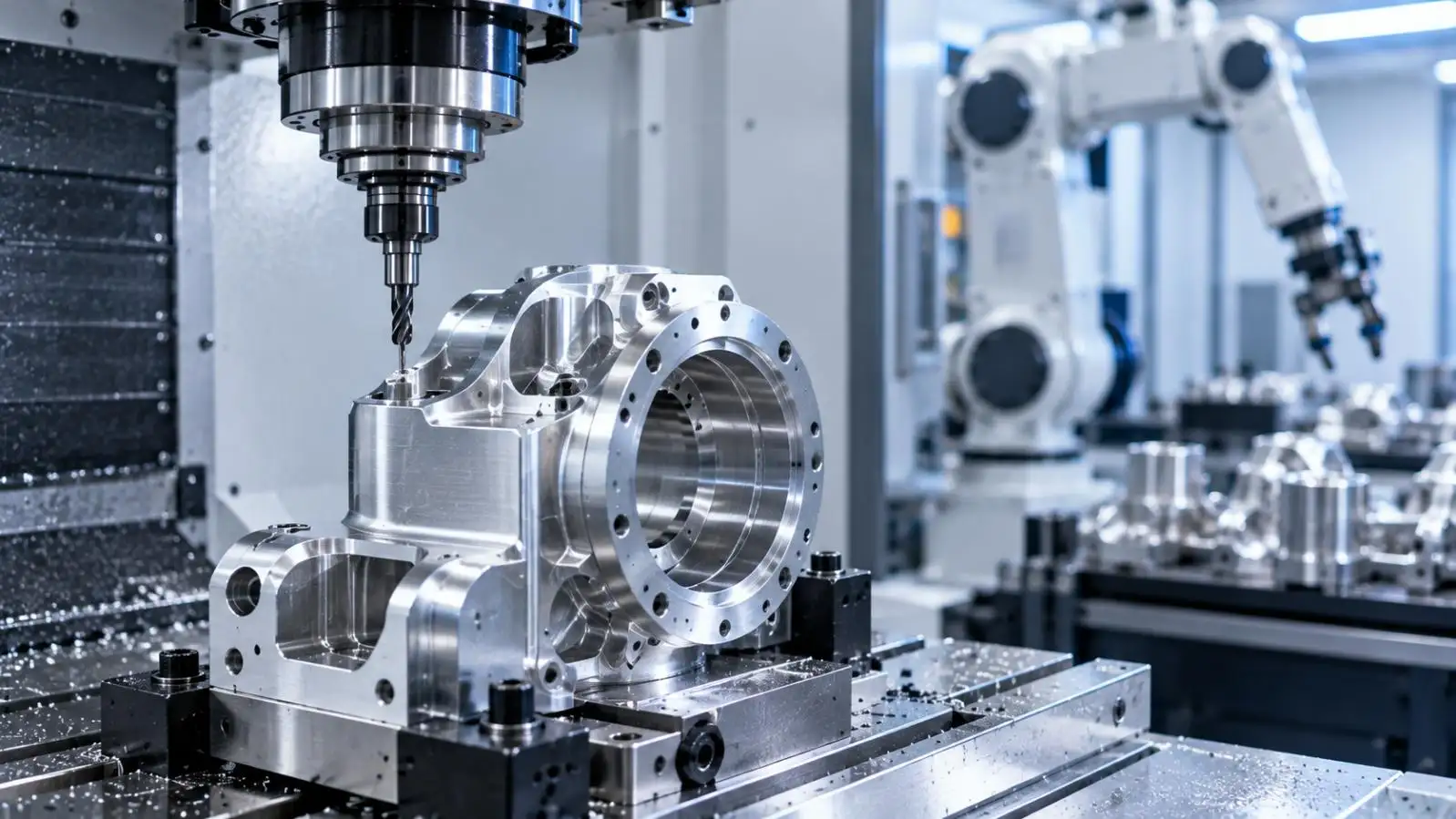
KT TOOL operates more than 70 CNC centers, including DMG MORI, Mazak, and Haas equipment. Simultaneous 5-axis machining can reduce repositioning errors on complex multi-surface housings.
Extrusion + CNC
Useful when Metal Housing Parts have a continuous cross-section, such as electronic controller or heat-dissipation enclosures.
Die Casting + Secondary Machining
Better suited to higher production volumes where thin walls, ribs, bosses, and complex enclosure geometry can justify tooling.
KT TOOL also supports die casting with in-house tooling and secondary CNC machining, allowing a prototype CNC housing to be reviewed for potential high-volume process conversion.
Sheet Metal Fabrication
For thin structural shells, laser cutting, bending, punching, and welding can sometimes achieve lower weight with less material removal than billet machining.
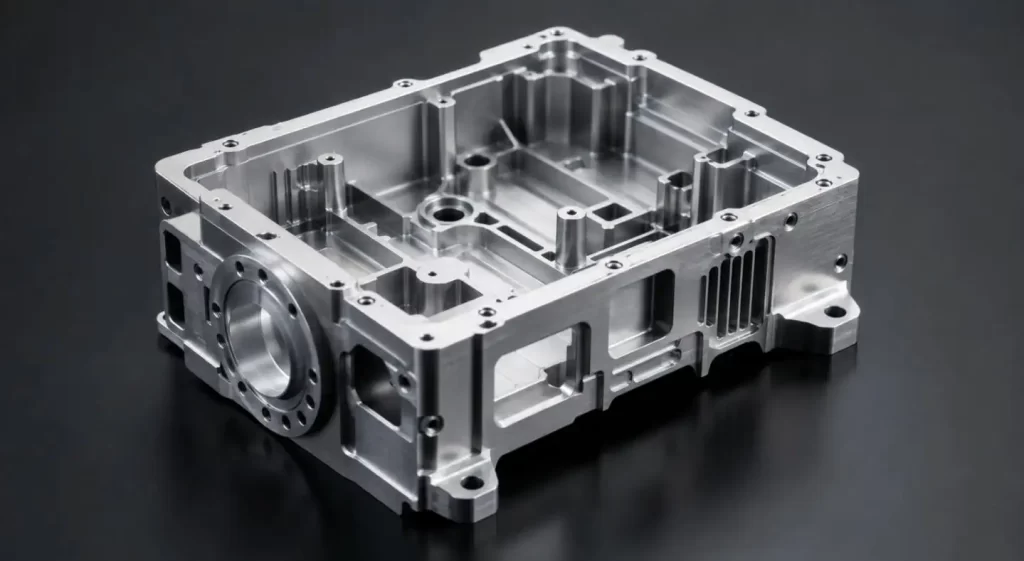
Do Not Remove Material From Functional Interfaces Blindly
Several areas of Metal Housing Parts should be treated as structurally critical.
| Housing Area | Risk of Excessive Lightweighting |
| Gasket flange | Loss of flatness and sealing pressure |
| PCB boss | Vibration or cracking |
| Threaded hole | Thread stripping |
| Heat-spreader surface | Reduced thermal contact |
| Connector wall | Positional misalignment |
| Bearing or precision mount | Loss of geometric accuracy |
Thermal performance also matters. Removing aluminum around a heat-producing component may reduce mass but also reduce the cross-sectional area available to spread heat.
Lightweight design therefore requires a system-level review, not only a mechanical weight calculation.
Design for Assembly and Maintenance
A housing that passes static analysis can still fail during installation.
Check:
•Thread engagement around thin sections
•Bolt tightening loads on flanges
•Insert requirements for repeated assembly
•Tool access around ribs
•Connector insertion forces
•Service access after final assembly
Uniform wall transitions are also important. Sudden changes from thick sections to very thin pockets may increase stress concentration and machining instability.
Validate Before Production
FEA allows for the detection of displacement and stress concentration as well as weak panels in design; however, simulation cannot and should not take the place of Real and Dimensional validation.
Critical Metal Housing Parts should define functional GD&T around:
•Datum surfaces
•Hole position
•Flatness
•Profile
•Sealing surfaces
ASME Y14.5 or ISO 1101 may be used according to the customer's drawing system. General dimensional requirements may reference ISO 2768-1 where appropriate, while general geometrical specifications should be reviewed against current ISO 22081 requirements rather than automatically applying the withdrawn ISO 2768-2.
Environmental requirements also need application-level validation. IEC 60529, for example, applies to complete enclosure protection testing; a machined housing alone should not automatically be described as "IP67."
KT TOOL combines in-process inspection with CMM verification and material traceability. Critical CNC features can be produced to drawing-specific tight tolerances, while standard features should use practical tolerances to avoid unnecessary machining cost.
Closing Words
For lightweight Metal Housing Parts, KT TOOL can review wall thickness, pocket geometry, ribs, tolerances, material selection, and machining access before production. With 3-axis, 4-axis, and simultaneous 5-axis CNC machining, CMM inspection, ISO 9001:2015 quality management, and support from prototype through production, the engineering team can help identify where weight can be removed without creating unnecessary manufacturing or reliability risks.
If you are producing like components of Metal Housing Parts, forward your CAD model along with your 2D drawing for manufacturability review to KT TOOL for a quotation.
FAQs
Q1. Does KT TOOL provide 5-axis machining for complex Metal Housing Parts?
Yes. KT TOOL employs 5-axis machining to process complex multi-surface parts. When applied to Metal Housing Parts, 5-axis machining decreases the need for multiple setups, improves consistency of reference surfaces, and allows for better access of the cutting tools to the angled surfaces, pockets, ports, and other complex features.
Q2. Which materials does KT TOOL recommend for lightweight Metal Housing Parts?
Lightweight Metal Housing Parts typically utilize the aluminum alloys. Their favorable strength-to-weight ratio, excellent machinability, good corrosion resistance, and ability to conduct heat make them suitable for this application. In addition to aluminum alloys, KT TOOL also offers machining services to stainless steel, titanium, brass, and carbon steel and in addition to these materials, machining services can be offered for other materials based on requirements of strength, corrosion resistance, and service conditions.
Q3. Can KT TOOL machine thin-wall Metal Housing Parts?
Yes. KT TOOL is committed to thin-wall CNC machining. However, the limit of wall thickness is dependent on several factors, such as size of part, unsupported wall, material, pocket depth, how part is held, and tolerance. Thin wall designs should be evaluated and reviewed prior to production to reduce the risk of wall distortion and loss of rigidity.
Q4. How does KT TOOL reduce the weight of Metal Housing Parts?
Instead of indiscriminately reducing wall thickness, designs can be optimized by the removal of material that does not serve a function, substitution of material, and so on. This can be done while preserving the integrity of the surfaces that seal and mount.
Q5. What tolerances can KT TOOL achieve on Metal Housing Parts?
With respect to Metal Housing Parts, KT TOOL can achieve a range of tolerances, including both standard and precision tolerances, at its discretion. Generally, critical dimensions can typically be manufactured at ±0.05 mm and may be made to tighter tolerances, while highly precise dimensions may be evaluated on a case-by-case basis. Where applicable, ±0.001 mm tolerances, as well as very tight tolerances, can be achieved depending on the part’s geometry, material, the method of measurement, and the manufacturing process conditions.
Talk to the Manufacturer, Not a Middleman
Resources & Insights
-
 Industry Insights
CNC Machining Robotic Parts: How GD&T Controls Robot Assembly Accuracy
2026-09-24By KT Engineering -
 Industry Insights
Hardware Stamping Springback Control for High-Strength Steel Parts
2026-09-24By KT Engineering -
 Industry Insights
Spring Stamping Fatigue Life: How Geometry, Material and Edge Quality Affect Cycle Life
2026-09-24By KT Engineering -
 Industry Insights
Mechanical Automation Parts for Robot End Effectors and Positioning Accuracy
2026-09-23By KT Engineering