Contact Us
  Home /
 Precision Metal Stamping Process


Table of Contents
- What Is Precision Metal Stamping?
- How the Precision Metal Stamping Process Works
- Types of Stamping Presses
- Advantages of Precision Metal Stamping
- Industries That Rely on Precision Metal Stamping
- Quality Control in Precision Stamping
- Design Tips for Better Stamped Parts
- Choosing the Right Precision Metal Stamping Partner
- Final Thoughts

Precision metal stamping is one of the most effective manufacturing methods that can create high quality metal components with an unparalleled level of accuracy and consistency. Precision stamping technology can be used to produce millions of parts with millimetrically close tolerances and lower manufacturing costs, ranging from automotive connectors to medical devices, from aerospace components to consumer electronics.
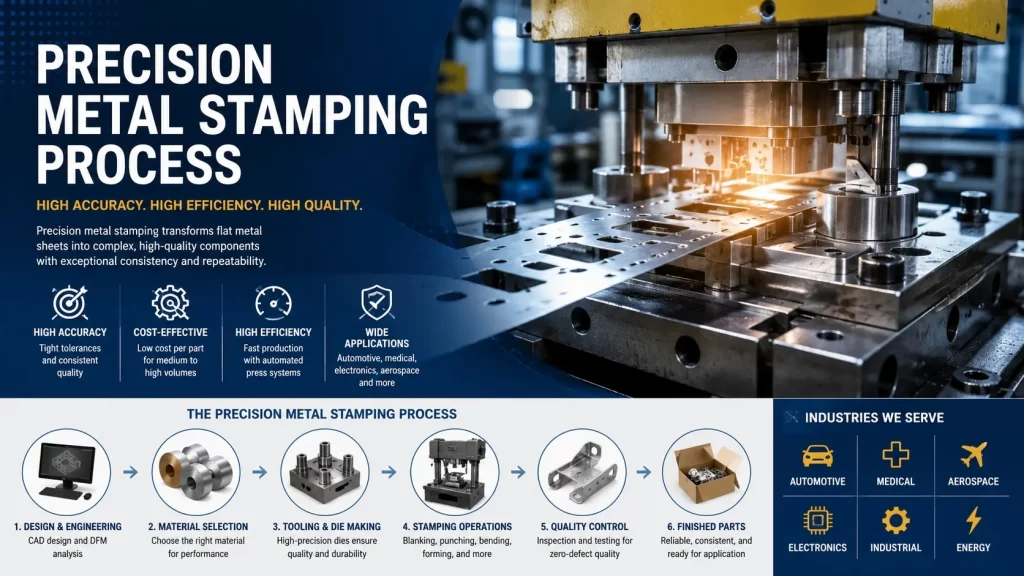
With advanced tooling, automation, CAD/CAM design, and intelligent quality control systems, precision stamping has developed and is now used in the manufacture of lighter, stronger, and more complex metal parts for industries. This guide covers everything from the precision metal stamping process and its advantages, to common pieces of equipment, its applications, and how to select the right metal stamp manufacturer.
What Is Precision Metal Stamping?
Precision metal stamping is a production method that uses high tonnage stamping presses and special precision parts, which is a cold working manufacturing process suitable for processing metal plates or metal coils with precise dimensions and complex shapes.
Precision stamping is a process that bends the metal under constant pressure, in contrast to cutting away material in conventional machining. This then enables manufacturers to create complex geometries in a rapid fashion while reducing waste and guaranteeing high repeatability.
The process can carry out several operations in a single production cycle, such as:
- Blanking
- Punching
- Piercing
- Bending
- Coining
- Embossing
- Forming
- Deep drawing
- Tapping
Precision stamping is well suited to medium to high volume manufacturing operations, as these operations are automated.
How the Precision Metal Stamping Process Works
Although every project is unique, most precision stamping projects follow these six stages.
1. Product Design and Engineering
Every successful stamping project begins with detailed engineering.
Design engineers evaluate:
- Part geometry
- Material thickness
- Required tolerances
- Surface finish
- Functional requirements
- Assembly methods
Today, 3D CAD software and Design for Manufacturability (DFM) analysis are used by modern manufacturers to fine-tune their components before tooling starts. There are lower manufacturing costs due to early engineering reviews which also enhance part quality.
2. Material Selection
The selection of the right material has a great impact on the performance of the product and on manufacturing efficiency.
The following are some of the most common stamping materials:
- Stainless steel
- Carbon steel
- Aluminum
- Copper
- Brass
- Phosphor bronze
- Nickel alloys
- Titanium
The materials have various properties like strength, corrosion resistance, conductivity, flexibility, formability etc.
The thickness, hardness, and grain direction of the material also need to be taken into account during the die design process.
3. Tooling and Die Manufacturing
The stamping die is the heart of the manufacturing process.
Precision tooling is comprised of:
- Upper die
- Lower die
- Punches
- Guide pins
- Strippers
- Inserts
They are produced by toolmakers with very close tolerances by CNC, WEDM, grinding and polishing.
High-quality tooling ensures:
- Long production life
- Minimal maintenance
- Consistent dimensions
- Reduced scrap rates
While tooling is a cost up front, for large production runs, the unit cost is dramatically reduced.
4. Metal Stamping Operations
After the tools are taken into the press, the metal sheet or coil is automatically fed into the metal sheet auto-feeding press.
For some products, multiple operations can happen concurrently.
Blanking
Blanking is a process used to create the basic form of metal.
Punching
Punching is used to make holes or slots with high positioning accuracy.
Bending
A controlled force will bend the metal into exact angles but not too much.
Forming
Forming is used to create three-dimensional objects from the material.
Coining
Coining is a process of applying a high pressure to the components to achieve detailed surface features, logos or fine dimensional accuracy.
Deep Drawing
Deep drawing is a method of stretching sheet metal into cups, housings and cylindrical parts without compromising the integrity of the product.
Many manufacturers use progressive dies with more than one operation, to achieve maximum productivity.
Types of Stamping Presses
Depending on the production volume, material and part complexity, the right press is selected.
Mechanical Presses
Mechanical presses use a flywheel to generate force.
Advantages include:
- High production speed
- Excellent repeatability
- Lower operating costs
- Ideal for thin materials
They are widely used for electronics, connectors, brackets, and automotive components.
Hydraulic Presses
Hydraulic presses generate force through hydraulic cylinders.
Benefits include:
- Adjustable pressure
- Longer stroke lengths
- Better control for deep drawing
- Suitable for thicker materials
Hydraulic systems excel when manufacturing large or complex components.
Servo Presses
Servo-driven presses combine the speed of mechanical systems with programmable motion control.
They provide:
- Improved energy efficiency
- Better forming accuracy
- Reduced vibration
- Longer tool life
- Enhanced process flexibility
Servo technology has become increasingly popular in modern smart factories.
Advantages of Precision Metal Stamping
Manufacturers choose precision stamping because it delivers outstanding productivity and consistent quality.
Key benefits include:
High Accuracy
Modern stamping dies can repeatedly produce parts with extremely tight dimensional tolerances.
Cost Efficiency
Although tooling costs are higher initially, mass production dramatically reduces the cost per component.
Fast Production
Automated press lines can manufacture thousands of parts every hour.
Excellent Repeatability
Every component is produced using identical tooling, ensuring consistent quality across large production batches.
Minimal Material Waste
Optimized nesting and progressive die designs improve material utilization and reduce scrap.
Scalability
Precision stamping supports everything from prototype development to millions of production parts.
Industries That Rely on Precision Metal Stamping
Precision stamping supports nearly every manufacturing industry.
Automotive
Applications include:
- Electrical terminals
- Sensor components
- Battery connectors
- Seat brackets
- Airbag components
- Motor laminations
Automotive manufacturers rely on stamping for lightweight, durable, and cost-effective parts.
Medical Devices
Medical manufacturers require extremely precise components such as:
- Surgical instruments
- Implant components
- Diagnostic equipment
- Catheter parts
- Micro-connectors
Strict quality control and clean manufacturing environments ensure regulatory compliance.
Aerospace
Aircraft components demand exceptional reliability.
Stamped aerospace parts include:
- Shielding
- Fasteners
- Connectors
- Structural clips
- Precision brackets
High-strength alloys and tight tolerances are essential.
Consumer Electronics
Modern electronics require miniature stamped components such as:
- Battery contacts
- EMI shielding
- Connectors
- Camera modules
- Smartphone components
Micro-stamping technology enables extremely small, intricate designs.
Quality Control in Precision Stamping
Consistent quality depends on rigorous inspection throughout production.
Manufacturers typically use:
- First Article Inspection (FAI)
- Coordinate Measuring Machines (CMM)
- Optical vision systems
- Digital microscopes
- Surface roughness testing
- Material certification
- Statistical Process Control (SPC)
Real-time monitoring helps identify deviations before they affect production quality.
Design Tips for Better Stamped Parts
Good part design improves manufacturability while reducing tooling costs.
Best practices include:
- Maintain uniform material thickness.
- Avoid unnecessarily sharp corners.
- Design holes away from edges.
- Consider bend radius limitations.
- Minimize secondary machining.
- Select materials suitable for cold forming.
- Collaborate with tooling engineers during product development.
Applying Design for Manufacturability (DFM) principles early shortens development time and lowers production costs.
Choosing the Right Precision Metal Stamping Partner
Not every supplier offers the same capabilities.
When evaluating a manufacturer, consider:
- Engineering expertise
- In-house tooling capabilities
- Advanced CAD/CAM systems
- ISO-certified quality management
- Material sourcing options
- Prototype support
- Production capacity
- Lead time performance
- Automated inspection equipment
- Industry experience
Having a good supplier can often help optimize your design, increase the efficiency of your production and lower the overall manufacturing cost.
Final Thoughts
Despite recent developments in other manufacturing methods, precision metal stamping is still one of the best ways to produce metal parts and components at scale with complex shapes and high precision. Using state-of-the-art tooling, automated press machines, smart quality control, and state-of-the-art engineering software, manufacturers can deliver an exceptionally consistent product, shorter production times, and reduced per-unit costs.
From automotive connectors to medical devices, aerospace components to electronics – the benefits of investing in precision metal stamping make it a reliable solution for high-volume production. This collaboration can help businesses bring a product to market quickly without compromising on product performance and manufacturing efficiency, while also ensuring they have access to an experienced manufacturer with engineering support, precision tooling and a strict quality assurance system in place.
Talk to the Manufacturer, Not a Middleman
Resources & Insights
-
 Hide blog post
CNC Machining Robotic Parts: How GD&T Controls Robot Assembly Accuracy
2026-09-24By KT Engineering -
 Hide blog post
Hardware Stamping Springback Control for High-Strength Steel Parts
2026-09-24By KT Engineering -
 Hide blog post
Spring Stamping Fatigue Life: How Geometry, Material and Edge Quality Affect Cycle Life
2026-09-24By KT Engineering -
 Hide blog post
Mechanical Automation Parts for Robot End Effectors and Positioning Accuracy
2026-09-23By KT Engineering