Contact Us
  Home /
 Which manufacturing process offers the shortest lead time?


Table of Contents
- What Is Manufacturing Lead Time?
- Lead Time Comparison of Common Manufacturing Processes
- 1. 3D Printing: The Fastest Manufacturing Process
- 2. CNC Machining: Fast and Highly Accurate
- 3. Sheet Metal Fabrication
- 4. Vacuum Casting
- 5. Injection Molding
- 6. Die Casting
- 7. Metal Stamping
- Factors That Affect Manufacturing Lead Time
- Which Manufacturing Process Is Best for Different Production Volumes?
- Tips to Reduce Manufacturing Lead Time
- Conclusion

In the current high competitive manufacturing environment, “time” can be as critical as quality and cost. If you're introducing a new product, manufacturing replacement parts or are suddenly being flooded with orders, choosing a manufacturing process with the fastest lead time can really impact the way you do business. The advantages of faster production are that it will reduce time to market, eliminate excess inventory and keep a company ahead of the competition.
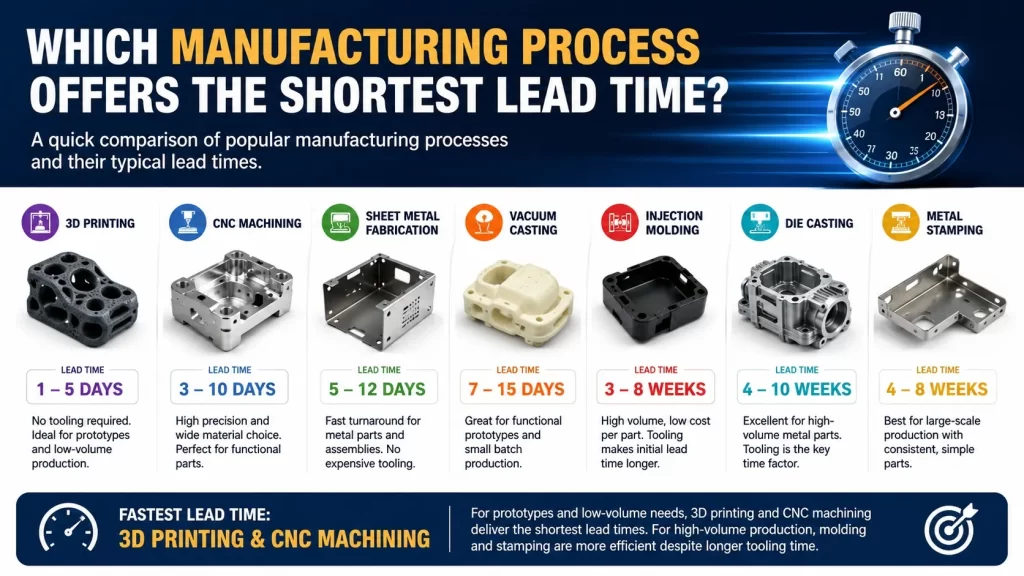
But with no one manufacturing technique guaranteed the fastest turnaround. The optimum process can vary from one application to another and will be dependent on production volume, part complexity, choice of materials, tolerances and finishing requirements.
This guide will explain the advantages and disadvantages of the most popular manufacturing processes so that you can make an informed decision on which has the shortest lead time for your project – CNC Machining, 3D Printing, Sheet Metal Fabrication, Injection Molding, Die Casting or Rapid Tooling.
What Is Manufacturing Lead Time?
Manufacturing lead time is the overall process time taken from order to delivery for manufacturing. It typically includes:
- Design review
- Engineering and DFM analysis
- Material procurement
- Tooling preparation (if required)
- Manufacturing
- Surface finishing
- Quality inspection
- Packaging and shipping
Shortening the lead time can enable businesses to launch products faster, speed up their product development process, and boost customer satisfaction.
Lead Time Comparison of Common Manufacturing Processes
| Manufacturing Process | Typical Lead Time | Best For |
|---|---|---|
| 3D Printing | 1–5 Days | Prototypes & Low Volume |
| CNC Machining | 3–10 Days | Precision Parts |
| Sheet Metal Fabrication | 5–12 Days | Metal Enclosures & Brackets |
| Vacuum Casting | 7–15 Days | Functional Prototype Runs |
| Injection Molding | 3–8 Weeks | High-Volume Plastic Parts |
| Die Casting | 4–10 Weeks | High-Volume Metal Components |
| Metal Stamping | 4–8 Weeks | Mass Production |
Additive Manufacturing and CNC machinery are the two types of manufacturing processes that typically have the shortest lead times, as they involve little or no tooling.
1. 3D Printing: The Fastest Manufacturing Process
When it comes to prototypes and small production runs, 3D printing is typically the quickest manufacturing method available.
Additive manufacturing is in contrast to traditional manufacturing methods where things are constructed layer by layer from CAD files. No mould, dies and no custom tooling required.
Advantages
- Production can begin immediately
- No tooling investment
- Ideal for complex geometries
- Rapid design iteration
- Low setup cost
Typical Lead Time
- Simple parts: 24 hours
- Functional prototypes: 2–5 days
- Small production batches: under one week
Best Applications
- Product development
- Medical devices
- Consumer electronics
- Automotive prototypes
- Aerospace concept models
The only limitation is that 3D printing becomes less economical for large production volumes.
2. CNC Machining: Fast and Highly Accurate
Where precision trumps speed, CNC machining is often the better choice.
As machining is based directly on digital CAD data there is no tooling delay.
Advantages
- Excellent dimensional accuracy
- Tight tolerances
- Wide material selection
- Superior surface finish
- Fast turnaround
Typical Lead Time
Most CNC parts can be delivered within:
- 3–7 days for standard projects
- 5–10 days for complex components
Suitable Materials
- Aluminum
- Stainless steel
- Brass
- Copper
- Titanium
- Engineering plastics
CNC machining is one of the fastest methods for producing production-quality metal components.
3. Sheet Metal Fabrication
Sheet metal fabrication is a combination of laser cutting, punching, bending, welding, and finishing.
There are no costly moulds and production can start early after engineering drawings are approved.
Typical Lead Time
- Laser cutting: 1–3 days
- Bending and welding: 2–5 days
- Complete assemblies: 5–12 days
Best For
- Electrical cabinets
- Server racks
- Machine housings
- Industrial equipment
- HVAC components
4. Vacuum Casting
Vacuum casting is a middle ground between prototype and injection molding.
A master model is either created with CNC or 3D printing and then silicone molds are manufactured for low volume manufacturing.
Lead Time
- Master model: 2–4 days
- Silicone mold: 2–3 days
- Casting production: 3–7 days
Overall lead time is usually between 7 and 15 days.
5. Injection Molding
Injection molding is the most cost effective of the processes for mass production; however, tooling is very costly and contributes to the lead time.
Tooling Phase
Designing and manufacturing a steel mold generally requires:
- Mold design: 1 week
- Mold manufacturing: 2–5 weeks
- Mold testing: 1 week
Only after tooling is complete can production begin.
Typical Lead Time
- Prototype mold: 2–4 weeks
- Production mold: 4–8 weeks
Once the mold is ready, thousands of parts can be produced every day.
6. Die Casting
The process of die casting is very similar to injection molding, except that it is used to manufacture metal components like Al, Zn and Mg.
Lead Time
Tool manufacturing is the primary factor affecting schedule.
Typical projects require:
- Tooling: 4–8 weeks
- Sampling: 1 week
- Production: several days
Although startup is slower, die casting is highly efficient for high-volume production.
7. Metal Stamping
Metal stamping requires progressive dies or transfer tooling before production begins.
Typical Lead Time
- Tool design
- Die manufacturing
- First article inspection
- Production
Overall lead time generally ranges from four to eight weeks.
However, once tooling is completed, production speeds are extremely high, often reaching tens of thousands of parts per day.
Factors That Affect Manufacturing Lead Time
Even within the same manufacturing process, lead time can vary based on several factors.
Part Complexity
Intricate geometries require additional programming, machining, or finishing.
Material Availability
Common materials such as aluminum and ABS plastic are usually available immediately, while specialty alloys may require longer procurement times.
Surface Finishing
Processes such as anodizing, powder coating, painting, polishing, or heat treatment can add several days to production.
Quantity
Small prototype orders are generally completed much faster than large production runs.
Supplier Capability
Experienced manufacturers with advanced equipment and in-house quality control often deliver significantly faster turnaround times than suppliers relying on outsourced processes.
Which Manufacturing Process Is Best for Different Production Volumes?
Prototypes
Best Choice: 3D Printing
Fastest turnaround with no tooling costs.
Functional Metal Parts
Best Choice: CNC Machining
Offers excellent accuracy and production-grade quality within days.
Small Batch Production (50–500 Parts)
Best Choice: CNC Machining or Vacuum Casting
Both provide relatively short lead times while avoiding expensive production tooling.
Medium Production (500–5,000 Parts)
Best Choice: Rapid Tooling + Injection Molding
Reduces mold manufacturing time while lowering part costs.
High-Volume Manufacturing
Best Choice: Injection Molding, Die Casting, or Metal Stamping
Although tooling takes longer initially, production efficiency makes these methods the most economical for large-scale manufacturing.
Tips to Reduce Manufacturing Lead Time
Manufacturers and buyers can shorten production schedules by following several best practices:
- Simplify part geometry where possible.
- Use standard materials that are readily available.
- Minimize unnecessary cosmetic finishes.
- Apply Design for Manufacturability (DFM) principles early.
- Consolidate multiple parts into a single design when feasible.
- Work with manufacturers that provide in-house machining, tooling, finishing, and inspection.
- Confirm design details before production begins to avoid costly revisions.
These strategies can reduce delays while improving overall production efficiency.
Conclusion
The length of the manufacturing process is related to your manufacturing goals and may be the briefest one.
3D printing provides the quickest turnaround time for prototypes and low volumes, which typically result in parts being made within days. CNC machining offers both speed and precise accuracy along with flexibility of production of metal and plastic parts. Another advantage of sheet metal fabrication is that fabricated assemblies can be made without custom tooling, and can be delivered quickly.
Processes that demand longer lead times for the development of the tools, like injection molding, die casting and metal stamping are used in high volume manufacturing. Once production starts, they are however, very efficient and cost effective in terms of cost per part.
To make the right choice in manufacturing process, one needs to take into consideration the lead time, production volume, cost, and material requirement and quality expectation. Working with a manufacturing supplier who has the expertise to provide multiple production capabilities can help you maximize delivery time and manufacturing success in the long run.
Talk to the Manufacturer, Not a Middleman
Resources & Insights
-
 Hide blog post
CNC Machining Robotic Parts: How GD&T Controls Robot Assembly Accuracy
2026-09-24By KT Engineering -
 Hide blog post
Hardware Stamping Springback Control for High-Strength Steel Parts
2026-09-24By KT Engineering -
 Hide blog post
Spring Stamping Fatigue Life: How Geometry, Material and Edge Quality Affect Cycle Life
2026-09-24By KT Engineering -
 Hide blog post
Mechanical Automation Parts for Robot End Effectors and Positioning Accuracy
2026-09-23By KT Engineering