Contact Us
  Home /
 Why is rapid prototyping important in product development?


Table of Contents
- What Is Rapid Prototyping?
- Why Rapid Prototyping Matters in Product Development
- 2. Identifies Design Problems Early
- 3. Reduces Development Costs
- 4. Improves Product Quality
- 5. Enhances Communication Among Teams
- 6. Supports Customer Feedback
- 7. Enables Functional Testing
- 8. Facilitates Investor and Client Presentations
- Popular Rapid Prototyping Technologies
- Industries That Benefit from Rapid Prototyping
- How Rapid Prototyping Improves Manufacturing
- Choosing the Right Rapid Prototyping Method
- Best Practices for Successful Rapid Prototyping
- Conclusion

Today's manufacturing environment is very competitive, and companies need to introduce new products to the market sooner than ever. In every market segment from consumer electronic products, medical electronics, automotive parts or industrial equipment, saving development time while meeting product quality is key. Rapid prototyping can play a crucial role in the product development process at this point.
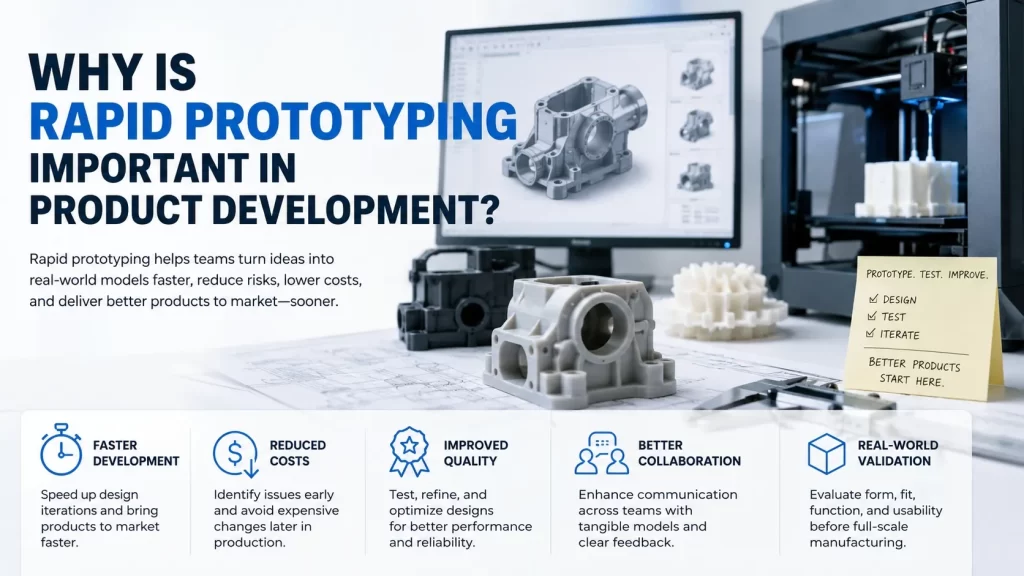
Rapid prototyping is a technology that helps designers, engineers and manufacturers quickly turn digital concepts into physical models. Traditional tooling takes weeks or months to evaluate, test and improve product designs, but that's not the case here. This leads to quicker innovation, lower development expenses and a better likelihood for market success.
Let's dive into the reasons for rapid prototyping in product development, its advantages, frequent technologies, and how businesses can utilize it to speed up product innovation.
What Is Rapid Prototyping?
Rapid prototyping is the process of manufacturing physical prototypes from advanced manufacturing technology directly from 3D CAD models. Rapid prototyping is contrasted from traditional manufacturing which relies on expensive molds or tooling to create models for design evaluation, and instead emphasizes the production of a working or visual model in a timely fashion.
There are a number of modern rapid prototyping fabrication processes, including:
- 3D Printing (Additive Manufacturing)
- CNC Machining
- Vacuum Casting
- Urethane Casting
- Sheet Metal Fabrication
- Rapid Injection Molding
Every technology is used for various development requirements, depending on the material, required precision, quantity and functionality.
Why Rapid Prototyping Matters in Product Development
1. Accelerates Product Development
The upside of rapid prototyping is that it is fast.
In traditional manufacturing, a lot of time and money is typically spent on designing and building tools to create a physical sample. Much of this delay is eliminated with rapid prototyping, because the engineer can get a prototype in a few days.
When a prototype is made quickly, it is:
- Shorter development cycles
- Earlier design validation
- Faster customer feedback
- Quicker market launch
Companies that can introduce products earlier often gain a significant competitive advantage.
2. Identifies Design Problems Early
Even the best CAD model cannot reveal every design issue.
A physical prototype allows engineers to inspect:
- Overall dimensions
- Part fit
- Assembly compatibility
- Ergonomics
- Mechanical movement
- Structural strength
Identifying these problems at an early stage avoids costly changes after the production tooling has been set up.
Validation of the design at an early stage in the design process greatly minimizes engineering risk.
3. Reduces Development Costs
As a project progresses, design changes are increasingly costly.
These costs can be reduced by using rapid prototyping, which allows for several design iterations prior to the start of mass production.
Manufacturers can test a variety of concepts with low-cost prototype parts to determine if a production mold is needed for thousands of dollars, or if it is not.
Typical saving is achieved through:
- Reduced tooling expenses
- Fewer engineering revisions
- Lower material waste
- Reduced production delays
- Fewer manufacturing errors
For startups and product developers with limited budgets, this cost efficiency is especially valuable.
4. Improves Product Quality
It takes several design iterations for high quality products to come out.
Rapid prototyping can be used for continuous improvement as the process involves testing and refining over and over again.
Engineers can evaluate:
- Functional performance
- Mechanical strength
- Surface finish
- Material selection
- Manufacturing feasibility
- User experience
Each prototype provides valuable data that contributes to a more reliable final product.
5. Enhances Communication Among Teams
Product development often involves multiple departments, including:
- Industrial designers
- Mechanical engineers
- Manufacturing engineers
- Marketing teams
- Suppliers
- Customers
In cases of a physical prototype, everyone will have a clear image of the product.
Each team can discuss a design using the same prototype, which minimizes misunderstandings and enhances collaboration.
6. Supports Customer Feedback
Many successful products are developed with customer input.
Rapid prototypes allow potential users to:
- Handle the product
- Evaluate ergonomics
- Test functionality
- Suggest improvements
- Identify usability issues
In practice, improvements that the designer may not have thought of often come to light through feedback.
The customer-centric approach results in improved products and improved customer satisfaction.
7. Enables Functional Testing
Rapid prototypes are not only limited to appearance models.
New advanced manufacturing technologies now make possible prototypes with engineering-grade materials for functional testing.
Manufacturers can evaluate:
- Load-bearing capacity
- Thermal resistance
- Mechanical wear
- Chemical compatibility
- Water resistance
- Electrical performance
Functional testing assists to confirm the product's performance before making the large scale production.
8. Facilitates Investor and Client Presentations
Realistic prototypes can be much more convincing than renderings.
Businesses that are looking for investment or customer endorsement can show that they:
- Product appearance
- Functional features
- Assembly process
- Market readiness
Physical prototypes increase confidence among investors, distributors, and business partners.
Popular Rapid Prototyping Technologies
3D Printing
3D printing builds parts layer by layer from digital models.
Advantages include:
- Fast turnaround
- Complex geometries
- Low setup costs
- Excellent for concept models
Common materials include plastic, resin, nylon, and metal.
CNC Machining
CNC machining removes material from solid blocks to create highly accurate prototypes.
Benefits include:
- Tight tolerances
- Excellent surface finish
- Engineering-grade materials
- Functional testing capability
It is ideal for metal and high-performance plastic components.
Vacuum Casting
Vacuum casting is suitable for producing small batches of plastic parts.
Advantages include:
- High-quality surface finish
- Flexible materials
- Cost-effective low-volume production
- Excellent for market testing
Rapid Injection Molding
When larger prototype quantities are required, rapid injection molding provides production-quality parts with lower tooling costs than conventional molding.
This process is ideal for pilot production and product validation.
Industries That Benefit from Rapid Prototyping
Rapid prototyping is widely used across numerous industries.
Automotive
Manufacturers develop:
- Interior components
- Engine parts
- Lighting systems
- Dashboard assemblies
- Functional test parts
Medical Devices
Medical companies create prototypes for:
- Surgical instruments
- Diagnostic equipment
- Medical housings
- Wearable devices
- Customized healthcare products
Consumer Electronics
Electronics manufacturers rapidly prototype:
- Smart devices
- Plastic enclosures
- Connectors
- Wearable products
- Home appliances
Aerospace
Engineers evaluate:
- Lightweight structures
- Complex brackets
- Airflow components
- Cabin interiors
Industrial Equipment
Manufacturers test:
- Machine components
- Custom fixtures
- Automation equipment
- Mechanical assemblies
How Rapid Prototyping Improves Manufacturing
Rapid prototyping also benefits manufacturing teams by identifying production challenges before mass production begins.
Engineers can optimize:
- Manufacturing processes
- Assembly efficiency
- Material usage
- Production costs
- Product reliability
Design for Manufacturability (DFM) becomes much easier when physical prototypes are available for evaluation.
Choosing the Right Rapid Prototyping Method
The best prototyping technology depends on project requirements.
Consider the following factors:
- Material requirements
- Dimensional accuracy
- Surface finish
- Mechanical strength
- Production quantity
- Budget
- Delivery time
Successful projects that are to be developed use several technologies at various stages of development.
For instance, a 3D printing method can be utilized for concept verification, a CNC machining method for functional testing, and rapid injection molding for pilot production.
Best Practices for Successful Rapid Prototyping
To maximize the benefits of rapid prototyping:
- Clearly define prototype objectives.
- Select materials that match end-use requirements.
- Test prototypes under realistic conditions.
- Gather feedback from engineering, manufacturing, and end users.
- Iterate designs based on test results.
- Consider manufacturability during every design revision.
Following these practices helps reduce development risks and improves product quality.
Conclusion
Rapid prototyping has revolutionized the current product development process by allowing companies to create, test, and improve their products in a much quicker time than ever before. It reduces development time, cost, product quality issues and manufacturing risk.
Whether you are developing your new consumer product, medical device, automotive part or industrial system, rapid prototyping allows you to innovate with confidence in flexibility. In the business world, addressing the challenge of designing products that are not fit for purpose, testing functions, and accelerating decision making can help get superior products to market and keep businesses competitive.
In an era of constantly changing manufacturing technologies, rapid prototyping will continue to be an essential resource for businesses aiming to speed innovation, boost efficiency, and ensure long-term success in product development.
Talk to the Manufacturer, Not a Middleman
Resources & Insights
-
 Hide blog post
CNC Machining Robotic Parts: How GD&T Controls Robot Assembly Accuracy
2026-09-24By KT Engineering -
 Hide blog post
Hardware Stamping Springback Control for High-Strength Steel Parts
2026-09-24By KT Engineering -
 Hide blog post
Spring Stamping Fatigue Life: How Geometry, Material and Edge Quality Affect Cycle Life
2026-09-24By KT Engineering -
 Hide blog post
Mechanical Automation Parts for Robot End Effectors and Positioning Accuracy
2026-09-23By KT Engineering