Contact Us
  Home /
 Stamping Supplier in China: Dongguan Precision Tooling and Metal Stamping Guide


Table of Contents
- What Does a Stamping Supplier Actually Need to Control?
- Why Dongguan Remains a Key Hub for Precision Tooling Manufacturing
- How Manufacturing Clusters Can Shorten Tooling Lead Time
- Precision Stamping Is Becoming More Demanding
- Progressive Die vs. Single Die: Which Is Better?
- Where Dongguan Holds a Competitive Manufacturing Advantage
- How KT TOOL Applies This Manufacturing Model
- KT TOOL Progressive Stamping Capability
- Engineering the Tool Before Production

Why are global manufacturers still sourcing precision stamping and tooling from Dongguan when labor cost is no longer the main purchasing consideration?

The answer increasingly lies in the manufacturing ecosystem. Choosing a Stamping Supplier today means evaluating tooling development, machining support, material sourcing, dimensional control, die maintenance, secondary processing and production scalability—not simply comparing press rates.
Why is Dongguan competitive for metal stamping?
Dongguan remains competitive because precision stamping depends on an interconnected manufacturing network. Tool design, CNC machining, grinding, EDM, heat treatment, material supply, surface finishing, inspection and assembly can be coordinated within a concentrated industrial region.
This manufacturing base remains substantial. In 2025, Dongguan's secondary industry generated RMB 716.544 billion and represented 56.1% of the city's GDP.
What Does a Stamping Supplier Actually Need to Control?
A capable Stamping Supplier does more than operate stamping presses. Reliable production depends on controlling the complete process:
Part Review → Strip Layout → Die Design → Tool Manufacturing → Trial → Process Optimization → Production → Inspection → Maintenance
| Manufacturing Stage | Key Control | Typical Risk |
| Part review | Geometry, tolerance, material | Unrealistic specifications |
| Strip layout | Pitch, carrier, material utilization | Excess scrap |
| Die design | Station sequence, clearance | Unstable forming |
| Tool manufacturing | Insert accuracy, alignment | Dimensional variation |
| Trial stamping | Springback, burrs, cracking | Low yield |
| Production | Feed, speed, lubrication | Process drift |
| Inspection | Datums, dimensions, surface | Undetected defects |
For precision components, problems at one stage often affect several later operations. This is why tooling engineering capability is an important criterion when comparing a precision metal Stamping Supplier.
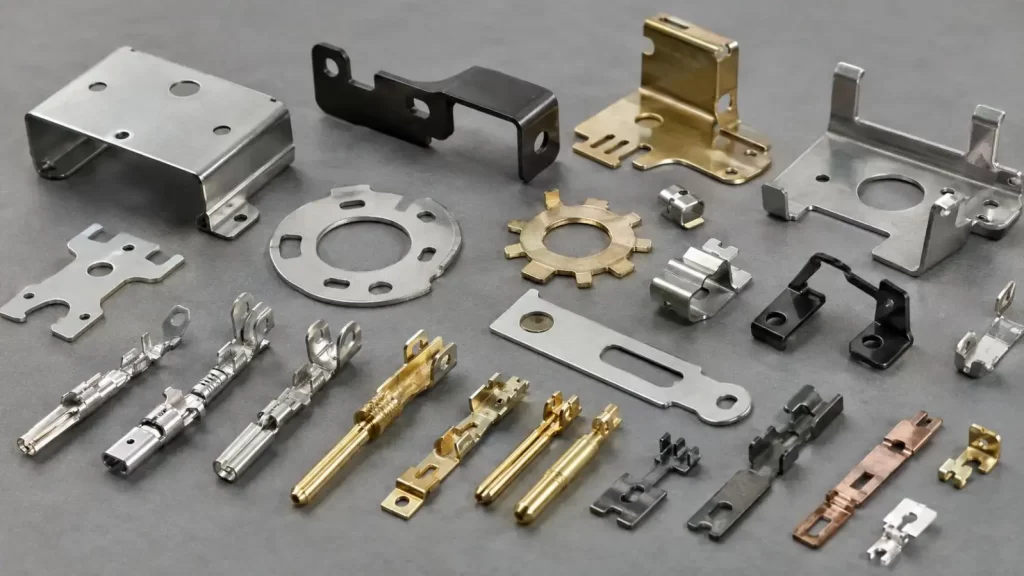
Why Dongguan Remains a Key Hub for Precision Tooling Manufacturing
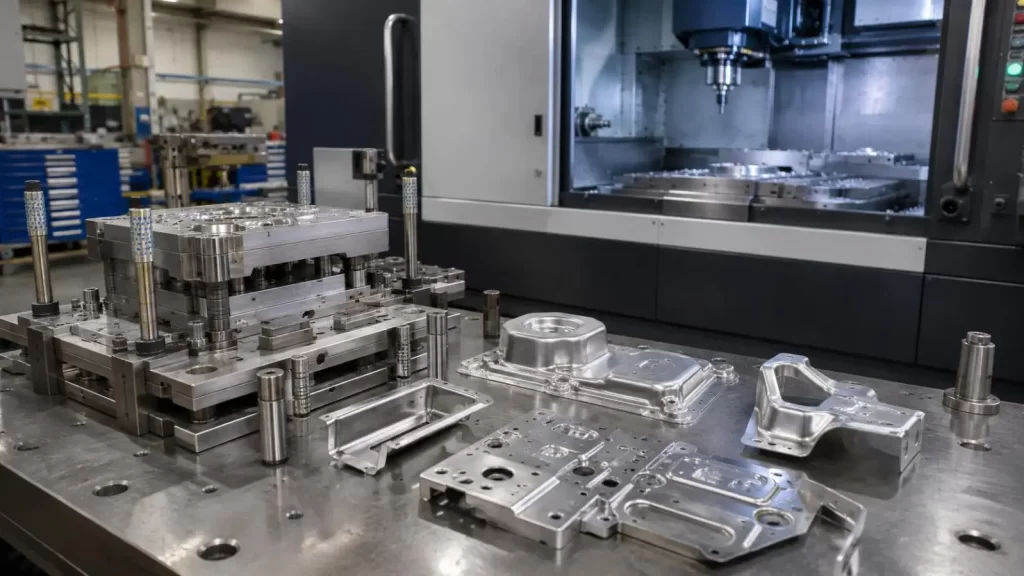
A stamping die is rarely produced through one machining process. Progressive and precision dies may require:
• CNC milling and turning
• Precision grinding
• Wire EDM and sinker EDM
• Heat treatment
• Die fitting and adjustment
• Surface treatment
• Dimensional inspection
The regional advantage of Dongguan is therefore not simply stamping capacity. It is access to complementary processes needed to manufacture, modify and maintain tooling.
In March 2025, Dongguan established an Industrial Machine Tool and Mold Innovation Consortium involving equipment companies, manufacturers, universities and research institutions. Its work includes precision machine tools, five-axis machining and advanced mold technologies for sectors such as automotive, electronics and aerospace.
How Manufacturing Clusters Can Shorten Tooling Lead Time
Progressive dies normally require trial and adjustment before production becomes stable.
A typical engineering loop may be:
Trial → Measure → Identify Deviation → Modify Insert → Regrind → Retest
When tooling, EDM, grinding, heat treatment and inspection are geographically separated, every correction may add transportation and communication time.
For this reason, buyers evaluating a Dongguan Stamping Supplier should ask more than:
How fast can the press run?
A more useful question is:
How quickly can the supplier identify, correct and verify a tooling problem?
Fast engineering feedback can be more important than nominal press speed during tooling launch.
Precision Stamping Is Becoming More Demanding
Modern Stamping Supplier projects increasingly combine tighter tolerances, thin materials, complex forming and higher production rates.
Tighter Dimensional Requirements
Critical characteristics may include:
• Hole-to-hole position
• Terminal pitch
• Flatness
• Bend angle
• Contact geometry
• Mating dimensions
More Challenging Materials
Stainless steel, high-strength steel, aluminum, copper and brass behave differently during forming. Material selection affects:
• Springback
• Burr formation
• Die clearance
• Lubrication
• Forming force
• Tool wear
Higher Stamping Speeds
High-speed stamping is not simply a matter of increasing strokes per minute. Feed accuracy, strip stability, pilot positioning, vibration, lubrication, slug removal and die temperature must remain controlled.
Longer Tool-Life Expectations
Low tooling price does not necessarily produce low manufacturing cost.
Buyers should also consider:
Tooling Cost + Scrap + Downtime + Maintenance + Insert Replacement + Material Utilization + Logistics
This provides a more useful picture of total production cost.
Progressive Die vs. Single Die: Which Is Better?
A professional Stamping Supplier should select tooling according to production requirements rather than automatically recommending the most complex die.
| Factor | Progressive Die | Single Die |
| Production Volume | High | Low–Medium |
| Initial Tooling Cost | Higher | Lower |
| Production Speed | High | Lower |
| Automation | High | Limited |
| Complex Multi-Step Parts | Strong | Moderate |
| Unit Cost at Scale | Lower | Usually higher |
| Tool Complexity | High | Lower |
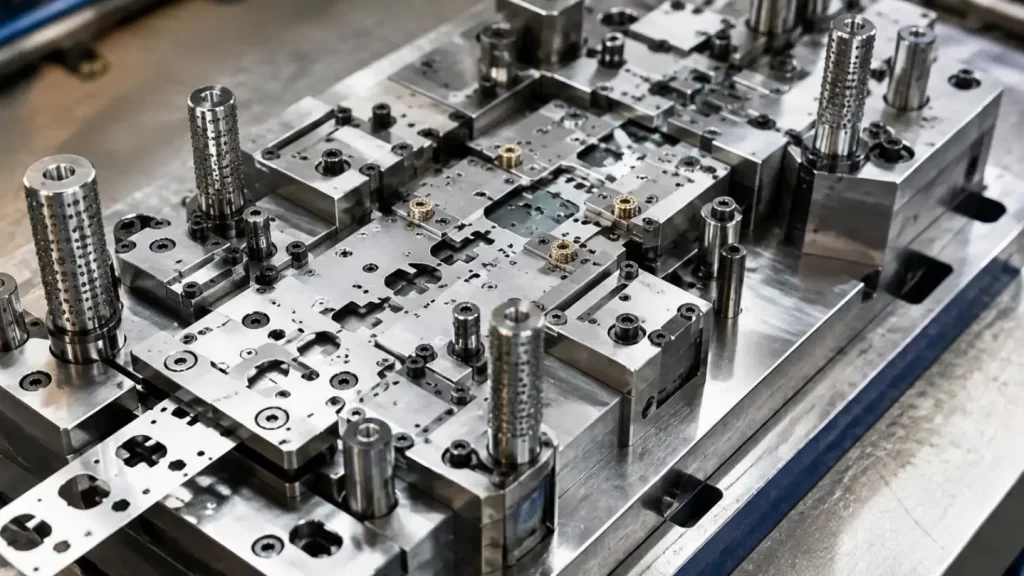
Progressive tooling is particularly effective when several cutting, piercing and forming operations can be integrated into one continuous strip. Single dies may remain more economical for simpler parts or lower production quantities.
Where Dongguan Holds a Competitive Manufacturing Advantage
A Dongguan Stamping Supplier can be particularly suitable for:
• Progressive die projects
• Connector terminals
• Automotive brackets
• Precision electronic components
• Small complex stamped parts
• Projects requiring repeated tooling modifications
• Parts combining stamping with CNC machining or sheet-metal fabrication
However, Dongguan is not automatically the best sourcing location for every project. Very large automotive panels may favor production close to vehicle assembly plants. Projects affected heavily by tariffs, freight costs or localization requirements must also be evaluated using landed cost rather than FOB price alone.
How KT TOOL Applies This Manufacturing Model
KT TOOL illustrates how a Dongguan-based Stamping Supplier can combine stamping engineering with supporting manufacturing processes.
Its capabilities include CNC milling and turning, 3-axis, 4-axis and 5-axis machining, grinding, sheet-metal fabrication, metal stamping, additive manufacturing, die casting, injection molding and finishing.
This integrated approach is useful when tooling requires precision inserts, locating components, CNC-machined fixtures, die modifications or secondary machining.
KT TOOL Progressive Stamping Capability
| Capability | Reference |
| Process | Progressive Die Stamping |
| Workpiece Materials | Stainless Steel, Aluminum, Brass, Carbon Steel |
| Die Materials | Tool Steel, Hardened Steel, Carbide |
| Stamping Tolerance | Approx. ±0.01–0.05 mm, geometry dependent |
| Production Speed | Up to 250–1500 strokes/min, application dependent |
| Tooling Types | Progressive, Compound, Single Die |
| Tool Materials | SKD11, SKD61, D2, SKH-9, RM56, ASP23 |
| Production Path | Prototype → Bridge Tooling → Mass Production |
| Quality Systems | ISO 9001 / ISO 13485 |
The applicable stamping tolerance depends on material thickness, geometry, feature relationships, forming sequence and tooling strategy rather than one universal specification.
Engineering the Tool Before Production
KT TOOL reviews factors such as material thickness, bend radius, hole-to-edge distance, forming direction, tolerance stack, burr direction, grain orientation and springback risk before tooling is finalized.
Die architecture can then be selected according to:
Volume + Geometry + Material + Tolerance + Expected Tool Life
Wear-prone punches and inserts may also require hardened tool steel, high-speed steel, ASP-series materials or carbide, while replaceable inserts and planned sharpening can simplify long-term maintenance.
Final Words
Selecting a Stamping Supplier is ultimately less about finding the lowest press rate and more about controlling the complete manufacturing system surrounding the stamped component.
Dongguan's investments center on the improvement of the quality of manufacturing and the establishment of advanced industrial clusters. The 2026-2028 initiative of manufacturing quality emphasizes the development of strong manufacturing systems, advanced manufacturing clusters, and increased competitiveness in manufacturing.
At the early stages of stamping projects, KT TOOL has the capability to analyze 2D drawings and CAD files, as well as determine the appropriateness of the materials, the critical tolerances, and the expected production volumes. Our engineering team can assist in determining the best approach among the options of single-die, compound-die, or progressive stamping, in order to achieve the desired level of production efficiency and dimensional control at the lowest possible cost for the tooling.
FAQs
Q1. What stamping services does KT TOOL provide?
KT TOOL provides flexible die stamping, multiple-operation die stamping, and individual-operation die stamping services. This versatility allows selection of the most appropriate die stamping service for a given use case.
Q2. What materials can KT TOOL stamp?
KT TOOL can stamp various materials including, but not limited to, stainless steel, aluminum alloys, brass and carbon steel. Considerations such as the material's mechanical properties, surface quality, and design requirements of the stamping will be addressed during the development of the stamping tool.
Q3. What tolerance can KT TOOL achieve for stamped parts?
The typical stamping tolerances for KT TOOL is in the range of ±0.01–0.05 mm. However, it is important to consider other factors such as the stamping sequences, design of the stamping tool and the features of the part. These factors may require special review.
Q4. Does KT TOOL manufacture progressive stamping dies?
KT TOOL manufactures progressive stamping dies which enable a high stamping production capacity. These dies are capable of accomplishing numerous operations due to the configuration of the stamping die stations.
Q5. What materials does KT TOOL use for stamping dies?
The dies can be manufactured from SKD11, SKD61, D2, SKH-9, RM56 or ASP23 tool steel. These dies can also be manufactured from tool steel and carbide with additional tool coatings for applications requiring improved wear resistance.
Talk to the Manufacturer, Not a Middleman
Resources & Insights
-
 Industry Insights
CNC Machining Robotic Parts: How GD&T Controls Robot Assembly Accuracy
2026-09-24By KT Engineering -
 Industry Insights
Hardware Stamping Springback Control for High-Strength Steel Parts
2026-09-24By KT Engineering -
 Industry Insights
Spring Stamping Fatigue Life: How Geometry, Material and Edge Quality Affect Cycle Life
2026-09-24By KT Engineering -
 Industry Insights
Mechanical Automation Parts for Robot End Effectors and Positioning Accuracy
2026-09-23By KT Engineering